Trump hosts Israeli Prime Minister Netanyahu at White House to discuss US plan to end Gaza war
Middle East, News, US September 30, 2025 Comments Off on Trump hosts Israeli Prime Minister Netanyahu at White House to discuss US plan to end Gaza war7 minute read
U.S. President Donald Trump secured the support of Israeli Prime Minister Benjamin Netanyahu for a U.S.-sponsored peace proposal aimed at ending Israel’s nearly two-year war in Gaza. The announcement came during Netanyahu’s fourth White House visit since Trump returned to office.
Speaking at a joint press conference on September 29, 2025, Trump declared the two leaders were “beyond very close” to achieving a peace agreement. He warned Hamas that Israel would receive full U.S. backing to take any measures it deemed necessary if the Islamist group rejected the proposal.
“Thank you for agreeing to the plan and for trusting that if we work together, we can bring an end to the death and destruction that we’ve seen for so many years, decades, even centuries, and begin a new chapter of security, peace, and prosperity for the entire region,” Trump said.
President Trump has proposed a 20-point framework, outlining a ceasefire, an exchange of hostages held by Hamas for Palestinian prisoners in Israel, a staged Israeli withdrawal from Gaza, Hamas disarmament, and the establishment of a transitional international administration for the enclave.
Standing beside Trump, Netanyahu said the U.S. plan aligned with Israel’s objectives. “I support your plan to end the war in Gaza, which achieves our war aims. It will bring back to Israel all our hostages, dismantle Hamas’ military capabilities, end its political rule, and ensure that Gaza never again poses a threat to Israel,” Netanyahu said.
Despite the show of unity, it remained unclear whether Hamas would engage. The group has not formally participated in the discussions, and a Hamas official told Reuters that it had not yet received the plan beyond what was reported in the media.

Trump’s Comprehensive Plan to End Gaza Conflict
The U.S. plan, drafted by Trump’s special envoy Steve Witkoff and advised by former presidential aide Jared Kushner, includes several stages:
- A ceasefire to be implemented immediately.
- The release of all remaining hostages held by Hamas within 72 hours, in exchange for hundreds of Palestinian prisoners.
- A phased Israeli withdrawal from Gaza.
- The disarmament of Hamas’ military wing.
- Governance of Gaza under a temporary international body, tentatively referred to as the Gaza International Transitional Authority (GITA).
The transitional authority would administer services and reconstruction with an initial budget of $90 million, increasing in subsequent years. Former British Prime Minister Tony Blair, who has worked closely with Kushner and Witkoff, is being considered to head the body. The plan also outlines humanitarian measures, including restoring daily aid deliveries to around 600 trucks, coordinated by the United Nations, the Red Crescent, and other neutral organizations.
The plan calls for a ceasefire once both sides accept the agreement, with Israeli forces withdrawing to an agreed line and all military operations suspended. Within 72 hours of Israel’s acceptance, all hostages, alive and deceased, must be returned. In exchange, Israel will release 250 life-sentence prisoners, 1,700 Gazans detained after October 7, 2023, including all women and children, and, for each Israeli hostage’s remains, the remains of 15 deceased Gazans. Humanitarian aid will begin flowing immediately, covering essential infrastructure such as water, electricity, hospitals, bakeries, rubble removal, and road access, under international supervision.
The governance framework for Gaza under this plan envisions a transitional technocratic Palestinian committee overseen by a newly formed international “Board of Peace,” chaired by Trump. This body will manage redevelopment until the Palestinian Authority completes its reform program and can securely assume control. Hamas members who surrender weapons and commit to peaceful coexistence will be granted amnesty, while those choosing to leave will be provided safe passage abroad.

All militant infrastructure is to be dismantled under international monitoring, with an arms decommissioning and reintegration program funded by global partners. To maintain stability, a U.S.-led International Stabilization Force will work with vetted Palestinian police, Israel, and Egypt to secure Gaza’s borders, prevent smuggling, and ensure the safe movement of aid and goods.
The plan also emphasizes Gaza’s economic transformation, with a development strategy designed to rebuild the Strip and create long-term opportunities for its people. A special economic zone will be established to attract investment, drawing on models from thriving Middle Eastern cities. Residents will not be forced to leave; instead, they will be encouraged to stay and participate in rebuilding a prosperous “New Gaza.”
The initiative promotes interfaith dialogue to shift public narratives toward peace and coexistence, while ensuring Gaza’s demilitarization through independent oversight. Ultimately, if reconstruction and reforms advance, the plan envisions conditions that could lead to Palestinian self-determination and statehood, supported by a U.S.-facilitated dialogue between Israel and the Palestinians.
Differences over Palestinian Authority’s Role
One of the most contentious elements is the potential role of the Palestinian Authority (PA). While the plan envisions eventual PA involvement after internal reforms, Netanyahu has long opposed giving the PA control over Gaza. “The PA must not control the territory,” Netanyahu said previously, despite the PA’s historic role in the Oslo Accords.
Trump’s plan stops short of promising Palestinian statehood but hints at a “vague path” toward that outcome once Gaza’s redevelopment is underway and reforms are in place. This remains a major sticking point. Netanyahu has vowed never to allow the creation of a Palestinian state, while several Western governments formally recognized Palestinian statehood at the United Nations last week, defying both Israel and the U.S.
Humanitarian Toll and Ongoing Fighting
The war, triggered by the October 7, 2023, attack that killed about 1,200 people and resulted in 251 hostages, has devastated Gaza. Israel says 48 hostages remain in Hamas’ hands, with 20 still alive.
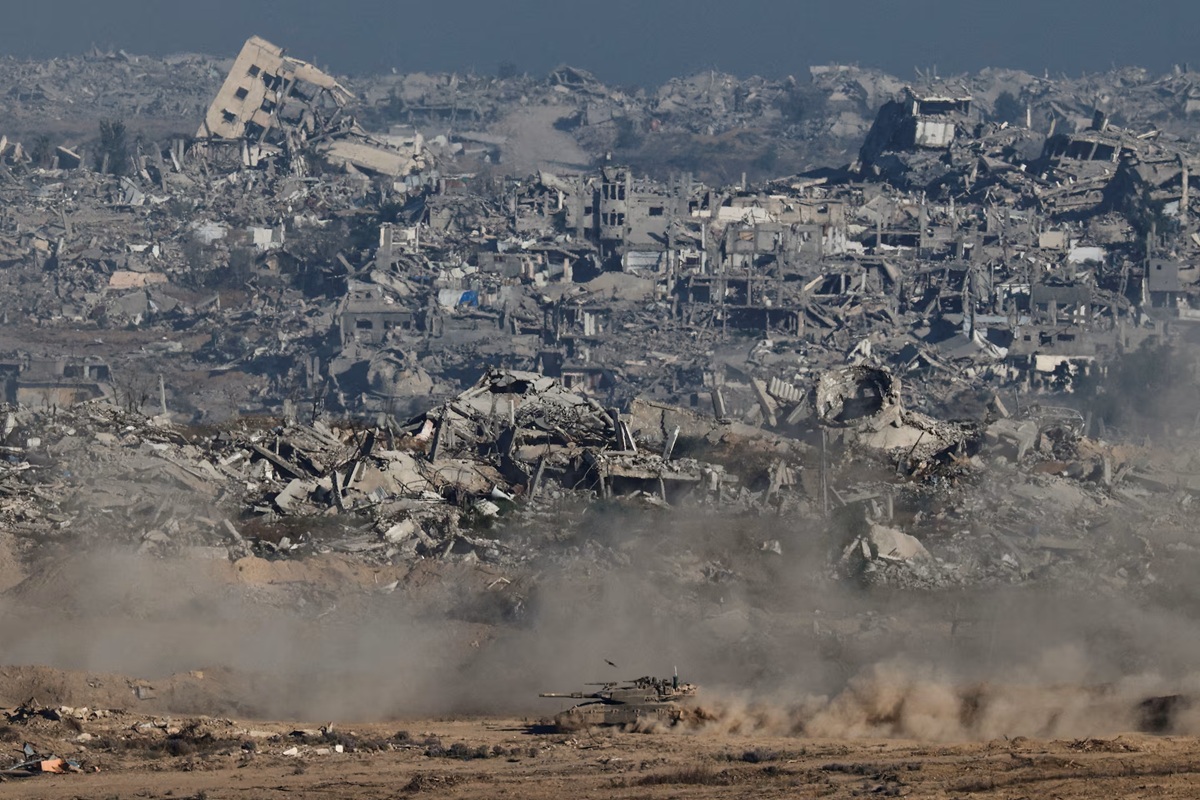
More than 66,000 Palestinians have been killed since Israel’s campaign began in Gaza, with vast parts of the enclave reduced to rubble. Israel has launched one of its largest offensives this month, targeting what Netanyahu described as Hamas’ “final redoubts.”
Trump’s push comes after repeated failures of U.S.-backed ceasefire efforts. Previous attempts collapsed over disagreements between Israel and Hamas, with Netanyahu insisting that fighting would continue until Hamas was completely dismantled.
Arab and International Reactions
The Trump administration presented the plan last week to leaders from Egypt, Indonesia, Jordan, Pakistan, Qatar, Saudi Arabia, Turkey, and the United Arab Emirates on the sidelines of the U.N. General Assembly. Trump has urged the Arab and Muslim leaders to bolster the plan’s legitimacy and to secure funding for Gaza’s reconstruction.
The proposal presented to the Arab and Muslim leaders incorporated parts of a separate blueprint recently published by former U.K. Prime Minister Tony Blair in Haaretz, which also calls for Hamas’ exclusion from governance and the installation of a transitional international authority. Blair has been advising Trump’s team for months.

Alignment with Limits
During his meeting with the U.S. president in Washington, Netanyahu praised Trump as “a friend of Israel,” but stopped short of endorsing every component of the U.S. plan, particularly regarding reforms demanded of the Palestinian Authority. It was not immediately clear whether Washington and Jerusalem had fully resolved these disagreements.
U.S. President Trump, who campaigned in 2024 on ending the Gaza war swiftly, has repeatedly claimed a peace deal was near. Monday’s event marked his most direct effort yet to close gaps with Israel and project progress on his promise. However, without Hamas’ consent, the initiative risks the same fate as past attempts.
Related Articles


IRIA Exclusive




IRIA Publications
Regions