









Ukraine’s FP-5 “Flamingo” Cruise Missile - Capabilities and Strategic Implications
IRIA Staff - August 28, 2025
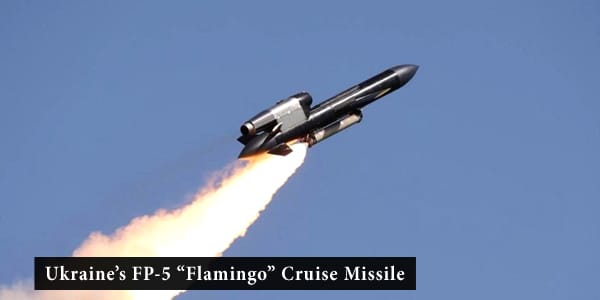
Ukraine has officially unveiled the FP-5 “Flamingo,” a domestically developed long-range cruise missile designed to strike deep into Russian territory. Developed by the Ukrainian defense start-up Fire Point, the missile represents one of the most ambitious weapons projects Kyiv has undertaken since the war began.
The introduction of the Flamingo cruise missile comes at a time when Russia continues its intensive missile and drone attacks against Ukrainian cities and infrastructure, while Kyiv faces political and operational limits on the use of foreign-supplied long-range weapons.
Ukrainian President Volodymyr Zelenskyy announced that the Flamingo had undergone successful tests and emphasized its importance as Ukraine’s most advanced missile to date. He further revealed that preparations were underway for mass production, to build from current small-batch production toward large-scale manufacturing by the end of 2025. The Flamingo would give Ukraine the ability to strike independently and consistently against targets that were previously out of reach.
FP-5 “Flamingo” Specifications
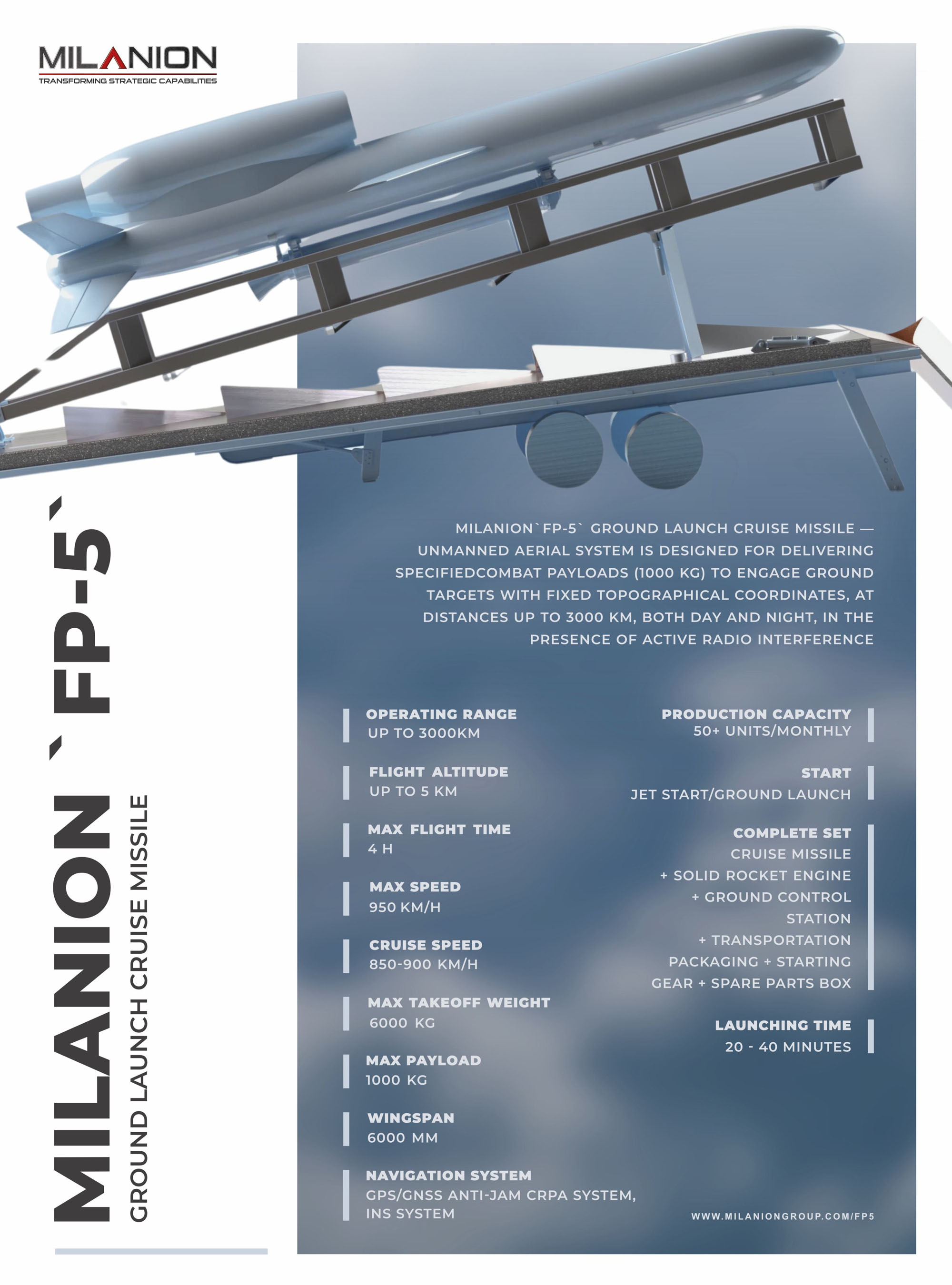
According to open-source information and Ukrainian disclosures, the Flamingo’s key features are as follows:
• Type: Ground-launched, subsonic cruise missile
• Range: Approximately 3,000 km
• Warhead weight: Around 1,150 kg (high-explosive or penetrator)
• Length: Estimated 12–14 meters
• Wingspan: Approximately 6 meters
• Launch weight: About 6 tons
• Engine: Likely Ivchenko AI-25 turbofan (repurposed from aircraft)
• Cruise speed: 850–950 km/h (high subsonic)
• Accuracy (CEP): Approximately 14 meters
• Guidance: Satellite navigation (GNSS) with inertial backup, resistant to jamming
• Launch platform: Fixed or mobile ground-based launchers
• Production rate: 1 per day currently, aiming for 7 per day by late 2025
These specifications place the Flamingo in the category of heavy, long-range land-attack cruise missiles, comparable in mission set to Russia’s Kalibr or even the American Tomahawk, though with a payload advantage.
Range
The Flamingo’s most striking feature is its range of about 3,000 kilometers. This puts almost the entirety of European Russia within reach, including critical industrial regions, military command centers, refineries, and transport hubs far from the Ukrainian border. In practice, this range provides planners with enormous flexibility. They can select circuitous flight paths to exploit radar gaps, bypass heavily defended areas, and time missile arrivals for coordinated strikes.
For Ukraine, this range is more than just about hitting targets; it represents strategic freedom. While Western-supplied missiles like Storm Shadow and SCALP are limited to around 250 kilometers in their export versions, and Germany’s Taurus has a range of 500 kilometers, Flamingo vastly extends the strike envelope. It allows Ukraine to plan campaigns against infrastructure that supports Russia’s war effort on a national scale rather than just at the tactical level near the front.
Payload
Equally significant is the Flamingo’s payload capacity of 1,150 kilograms. This figure is more than double that of Western cruise missiles such as Storm Shadow, SCALP, or Taurus, all of which carry warheads in the 450–480-kilogram range. The Flamingo’s payload falls into the same category as heavy free-fall bombs used by strategic aircraft, such as the Mk-84 or the BLU-109 penetrator bomb.
The immense payload opens up new target sets for Ukraine. Whereas lighter missiles are better suited to precision strikes against discrete facilities, the Flamingo’s heavy warhead makes it highly effective against hardened structures, large refineries, industrial plants, and bridges.
The missile’s kinetic energy and terminal velocity also mean that it can penetrate deeper into reinforced targets before detonating, magnifying its destructive effect. This makes it a weapon designed not just to disable but to obliterate critical infrastructure nodes.
Guidance and Accuracy
The Flamingo uses satellite navigation combined with an inertial navigation system. It is equipped with anti-jamming features to resist Russian electronic warfare, which has been a consistent challenge for Ukrainian drones and missiles. The reported accuracy of around 14 meters is sufficient for striking fixed infrastructure such as fuel depots, power stations, or military-industrial plants.
What the Flamingo appears to lack compared to Western missiles is advanced terminal guidance, such as infrared imaging seekers or terrain-following radar. This means it may not achieve the pinpoint precision required for mobile or small-scale targets. However, given its massive warhead, the Flamingo does not need pinpoint accuracy to achieve mission success. Against large fixed facilities, a margin of error of several meters still ensures devastating effects.
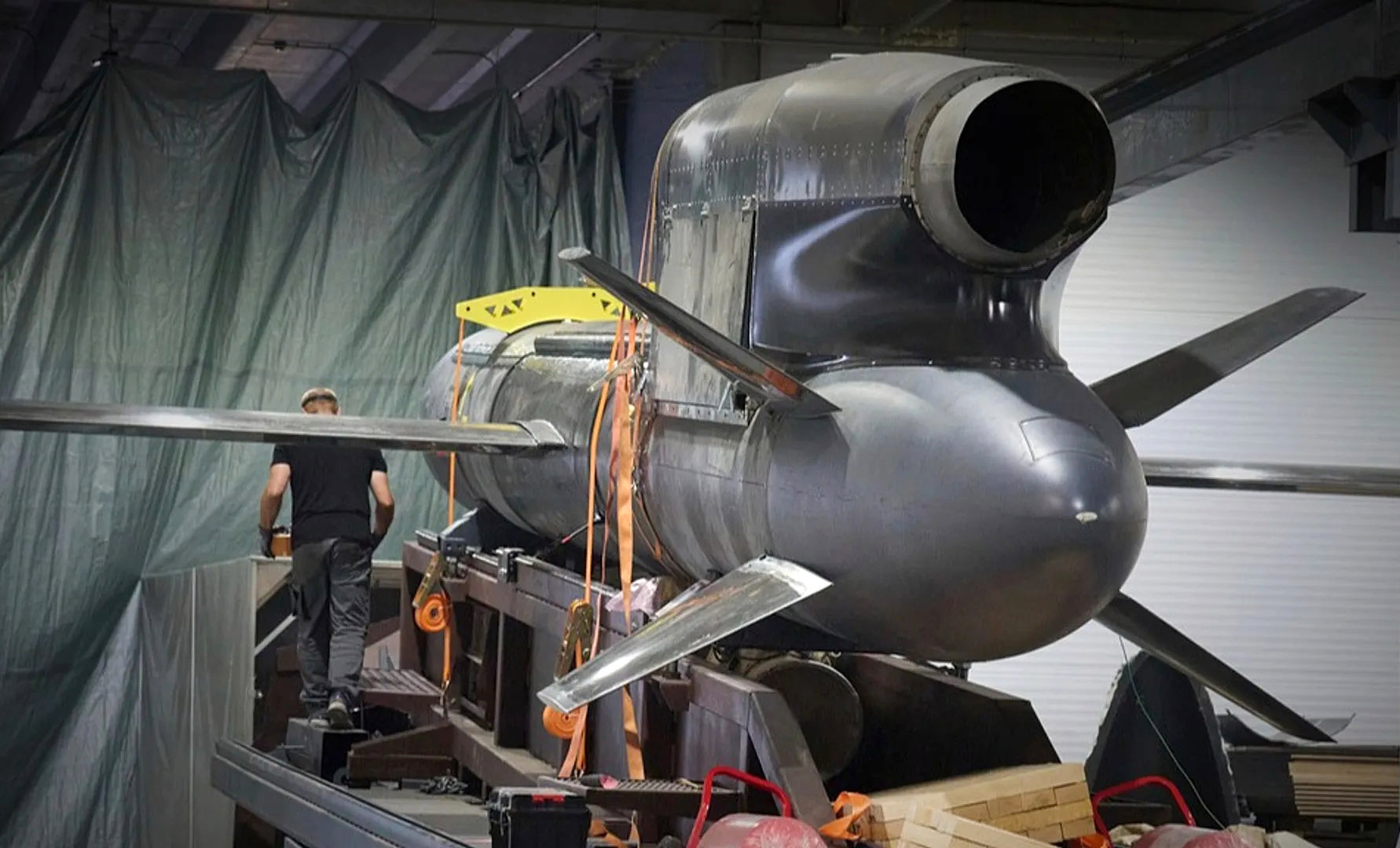
 Workers inspect a Flamingo cruise missile at Fire Point’s secret factory in Ukraine on August 18, 2025. (Image Credit: AP/Efrem Lukatsky)
Propulsion and Airframe
The Flamingo is powered by a turbofan engine, most likely derived from the Ivchenko AI-25, a Ukrainian engine originally used in training aircraft. Repurposing existing engines ensures cost efficiency and scalability, as Ukraine already has stockpiles of these engines or the industrial capacity to produce them.
The missile’s large size—over 12 meters long and weighing around 6 tons—suggests it is not optimized for stealth. Its radar cross-section is likely much higher than Western systems designed for low observability. Instead, its survivability relies on flying at very low altitudes, hugging terrain features, and overwhelming Russian defenses through massed salvos and decoys.
Production Capacity
Production capacity may ultimately determine the Flamingo’s impact on the war. Fire Point has stated that it is currently producing about one missile per day but aims to ramp up to seven per day by October. If achieved, this would give Ukraine more than 200 missiles per month, or about 2,500 missiles annually. Even if these figures prove overly optimistic, a consistent production of 30 to 50 missiles per month would still provide Ukraine with a meaningful stockpile.
The advantage of domestic production is that Ukraine no longer has to rely on foreign approvals to strike deep into Russia. The United States has restricted the use of ATACMS missiles inside Russian territory, while Germany has declined to transfer its Taurus missiles altogether. By manufacturing Flamingo domestically, Kyiv gains a weapon that can be employed without political constraints.
Survivability and Russian Air Defenses
Russia maintains one of the most extensive integrated air defense systems in the world, anchored by the S-300 and S-400 families of surface-to-air missiles. These defenses are designed to intercept cruise missiles at long and medium ranges. The Flamingo, being large and non-stealthy, will inevitably be detected and intercepted in some numbers. However, Ukraine’s approach is likely to use Flamingo in combination with swarms of drones, decoys, and smaller missiles to saturate Russian defenses.
By launching multi-axis, simultaneous attacks, Ukraine can force Russian air defense systems to track and engage more targets than they are designed to handle. Even if a portion of the Flamingo cruise missiles are intercepted, enough are likely to get through to cause serious damage. Over time, repeated strikes of this nature will strain Russia’s air defense stockpiles and force the diversion of critical resources away from offensive operations.
 Workers inspect Flamingo missiles at a secret Fire Point factory in Ukraine, on August 14, 2025. (Image Credit: Efrem Lukatsky/AP)
Comparison with Other Systems
Compared to Western missiles, Flamingo is less refined but more powerful. Storm Shadow, SCALP, and Taurus all carry smaller warheads but feature sophisticated guidance systems and stealth shaping. These weapons are excellent at precision strikes but are limited in range and availability. The Flamingo reverses this balance by prioritizing raw destructive power and range over finesse.
Against Russian systems, Flamingo matches or exceeds the Kalibr cruise missile in range and warhead size. The Kalibr typically has a 450-kilogram payload and a range of 1,500 to 2,500 kilometers.
Flamingo’s 3,000-kilometer reach and 1,150-kilogram payload give Ukraine, for the first time, a weapon that is broadly comparable or superior in destructive terms to Russia’s own long-range systems.
Strategic Implications
The Flamingo’s introduction has both immediate and long-term implications. In the near term, it provides Ukraine with the capacity to disrupt Russia’s war economy by targeting refineries, industrial plants, power grids, and transportation infrastructure deep inside Russian territory. This not only imposes economic costs but also complicates Moscow’s war logistics.
In the long term, the Flamingo may provide Ukraine with a credible deterrent. If Ukraine can build a stockpile of several thousand of these missiles, it will possess the capacity to strike at Russia’s economic heartlands within 24 to 48 hours. This creates a deterrent effect by raising the potential cost of any renewed aggression after the war ends. For Ukraine, which lacks nuclear weapons, such a conventional deterrent could become the strongest guarantee of its security.
The FP-5 Flamingo marks a significant milestone in Ukraine’s defense industry. With its 3,000-kilometer range and 1,150-kilogram payload, it gives Kyiv a weapon that can strike deep into Russian territory with devastating impact. While it lacks the stealth and precision of Western cruise missiles, its brute force design, heavy warhead, and potential for mass production make it uniquely suited to Ukraine’s needs.
 President of Ukraine Volodymyr Zelenskyy visited the frontline command post of the defenders of Kupyansk during a working trip to Kharkiv region, on November 30, 2023. (Image Credit: The Office of the President of Ukraine)
If Ukraine can achieve even modest monthly production levels, the Flamingo will become an important strategic tool, altering the balance of strike capabilities in the war. More importantly, it will allow Ukraine to act independently of Western political constraints, ensuring that Kyiv retains the initiative in its campaign against Russia’s war economy. Beyond the battlefield, the Flamingo symbolizes Ukraine’s determination to build an indigenous defense industry capable of sustaining long-term resistance and deterrence.
ALSO READ:
 Russia-Ukraine War
 Inside the Largest BVR Aerial Combat
Regions




Issues