








US Military’s Robotic X-37B Spacecraft on Secret Space Mission
IRIA Staff - August 30, 2025
The United States continues to expand its leadership in space technology with the launch of the X-37B Orbital Test Vehicle (OTV), a highly advanced robotic spaceplane operated by the U.S. Space Force in partnership with the Air Force Rapid Capabilities Office (AFRCO).
On August 21, 2025, the Boeing-built spacecraft embarked on its eighth mission (OTV-8), launched aboard a SpaceX Falcon 9 rocket from Kennedy Space Center, Florida. This mission underscores the strategic importance of reusable spacecraft for defense innovation, resilience, and space domain security.
The X-37B program remains one of the most closely watched elements of U.S. military space operations, largely because of its classified payloads and evolving mission objectives. While official details remain scarce, the spacecraft’s track record highlights its role as a testbed for technologies that will shape the future of space operations, communications, and navigation.
Origins and Evolution of X-37B
The X-37B is not simply a spacecraft. It is a symbol of U.S. strategic ambition in the contested space domain—a domain where resilience, adaptability, and technological superiority are rapidly becoming as important as traditional military strength on Earth.
The X-37 program originated at NASA in 1999, envisioned as a technology demonstrator to support future reusable spacecraft. Initially, NASA planned two vehicles: an Approach and Landing Test Vehicle and an Orbital Vehicle. By 2004, however, the program was transferred to the Defense Advanced Research Projects Agency (DARPA) and subsequently classified. In 2010, the U.S. Air Force assumed operational control, placing the spacecraft under the Rapid Capabilities Office.
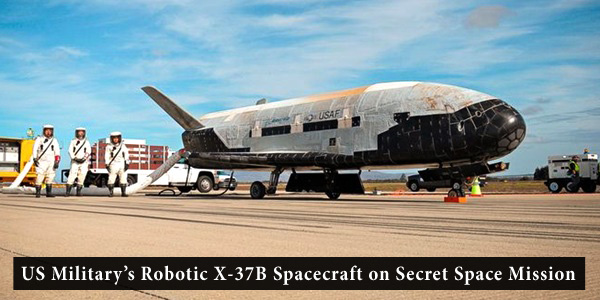
Boeing’s design, derived from shuttle heritage, resulted in a compact but robust vehicle: 8.8 meters long, 2.9 meters tall, with a wingspan just under 4.6 meters, and weighing about 4,990 kilograms at launch. Launched vertically atop a rocket, the spacecraft returns horizontally like an aircraft, landing on a runway for refurbishment and reuse. The program has since evolved from experimental origins to a strategic flagship, combining the expertise of the Air Force, Space Force, NASA, and industry partners into a platform that serves as both a testbed and a deterrent.
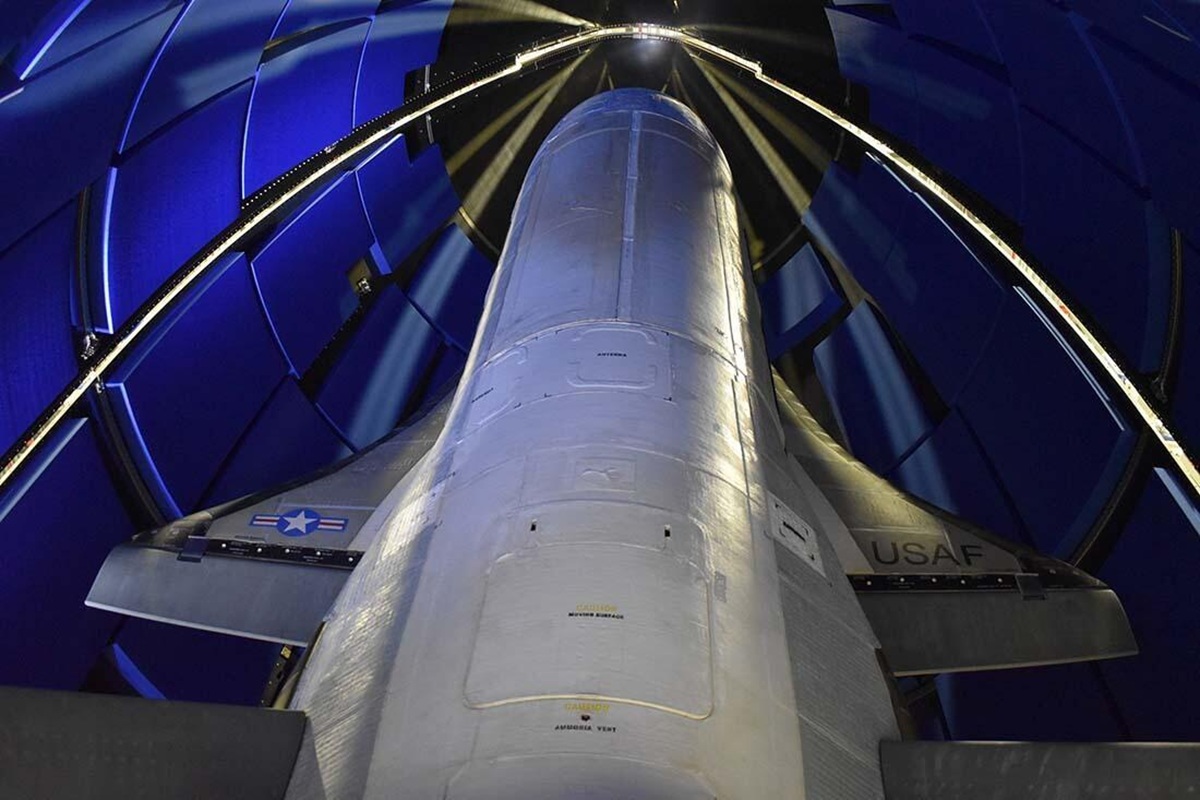 The Boeing-built X-37B spacecraft in preparation for launch. (Image Credit: U.S. Space Force/via Boeing)
Performance and Mission Record
Since its debut flight in April 2010, the X-37B has logged over 4,200 days in orbit across seven missions, amassing more than 1.3 billion miles of travel. Each mission has extended the limits of duration, such as Mission 5 lasted 780 days, while Mission 6 set a record of 908 days in orbit.
The spacecraft’s longevity and successful mission record demonstrate the reliability of reusable spacecraft for both military and scientific applications. The program has gradually expanded its objectives, adding a service module in its sixth mission to carry more experiments and broaden operational flexibility.
This endurance allows for prolonged experimentation and monitoring of new technologies in real-world orbital conditions. It also makes the X-37B a dynamic and unpredictable asset, able to shift orbits rapidly and execute maneuvers that complicate tracking by adversaries.
Former Secretary of the Air Force Heather Wilson remarked that the spacecraft’s ability to abruptly alter orbit could make it appear to “disappear” from imaging systems, driving rivals “nuts.” Such agility makes the X-37B uniquely suited for operating in a contested space environment, where survivability and maneuverability are as valuable as the experiments it carries.
Mission 8: Shaping the Future of Space Operations
The current mission, OTV-8 (USSF-36), underscores the spacecraft’s role as the premier test platform for the technologies of tomorrow. AFRCO Acting Director William Blauser described it as a demonstration of “mission-focused innovation” that continues to “redefine the art of the possible” in orbit.
According to the U.S. Space Force statement, "Mission 8 will contribute to improving the resilience, efficiency and security of U.S. spacebased communications architectures by conducting laser communications demonstrations involving proliferated commercial satellite networks in Low Earth Orbit."
Observers speculate that its missions may include testing counter-space capabilities, conducting intelligence-gathering experiments, and developing new orbital maneuvering techniques.
The U.S. government maintains that the platform is focused on testing reusability and enabling experiments that can be safely returned to Earth. However, the classified nature of its payloads leaves ample room for conjecture and contributes to the X-37B’s reputation as one of the most mysterious spacecraft in operation.
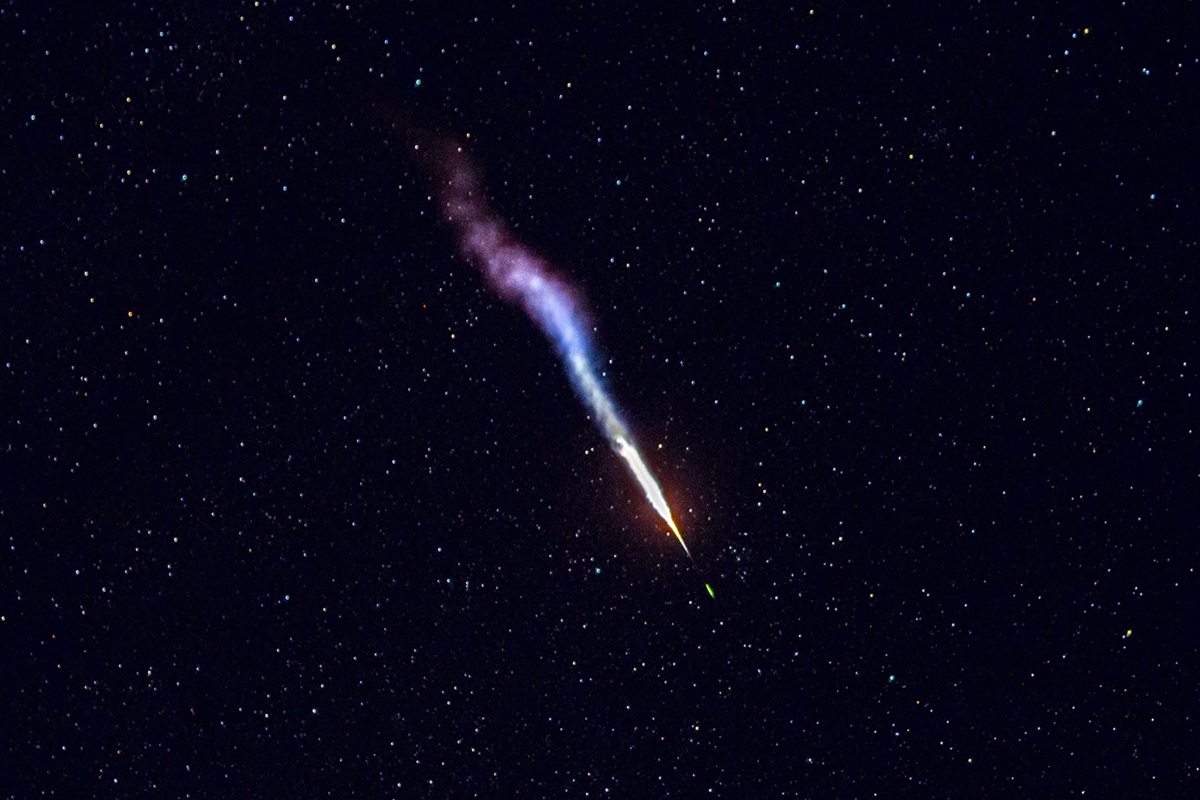 Falcon 9 launch of the X-37B Orbital Test Vehicle’s eighth mission to orbit. (Image Credit: SpaceX)
Laser Communications for Resilient Networks
The X-37B is testing inter-satellite laser communications with proliferated commercial satellite constellations in low Earth orbit. Laser links represent a leap forward by:
• Enabling higher data throughput than traditional radio-frequency systems.
• Offering greater resistance to jamming or interception.
• Enhancing redundancy by distributing communication across wide networks without single points of failure.
This capability supports the U.S. Space Force’s strategy to create resilient, secure, and redundant communications architectures critical for both peacetime operations and conflict scenarios.
Space Force Chief of Space Operations said in a statement, “OTV-8’s laser communications demonstration will mark an important step in the U.S. Space Force’s ability to leverage proliferated space networks as part of a diversified and redundant space architectures. In so doing, it will strengthen the resilience, reliability, adaptability, and data transport speeds of our satellite communications architecture.”
Quantum Inertial Sensing for GPS-Denied Navigation
The spacecraft carries the world’s most advanced quantum inertial sensor, designed to provide navigation without reliance on GPS. By measuring atomic interactions, the system can detect movement and orientation with extraordinary precision.
Such a capability is vital in environments where GPS is degraded or denied, a growing threat given adversary investments in electronic warfare and anti-satellite capabilities. Beyond Earth orbit, quantum navigation could support missions in cis-lunar space, expanding the U.S. ability to operate in the emerging frontier between Earth and the Moon.
Commander of Space Delta 9, Col. Ramsey Horn emphasized, “Whether navigating beyond Earth-based orbits in cislunar space or operating in GPS-denied environments, quantum inertial sensing allows for robust navigation capabilities when GPS navigation is not possible,” adding that “Ultimately, this technology contributes significantly to our thrust within the Fifth Space Operations Squadron and across the Space Force, guaranteeing movement and maneuverability even in GPS-denied environments.”OTV-8 is Falcon’s third launch of the X-37B, after previously launching OTV-5 and OTV-7 pic.twitter.com/BdKhzqumKK
— SpaceX (@SpaceX) August 22, 2025
Advancing Reusability and Autonomy
A defining feature of the X-37B is its ability to autonomously re-enter Earth’s atmosphere and land like an aircraft. This capability enables rapid refurbishment, reprocessing, and redeployment—an efficiency unmatched by traditional expendable spacecraft.
Its modular design allows researchers to host a wide range of experiments, from solar power transmission technologies to biological studies. Previous missions tested Naval Research Laboratory systems for converting solar energy into microwave power for ground transmission, as well as exposing plant seeds to space radiation to assess human sustainability on long-duration missions. Such versatility ensures the platform remains relevant to both defense innovation and broader U.S. space exploration objectives.
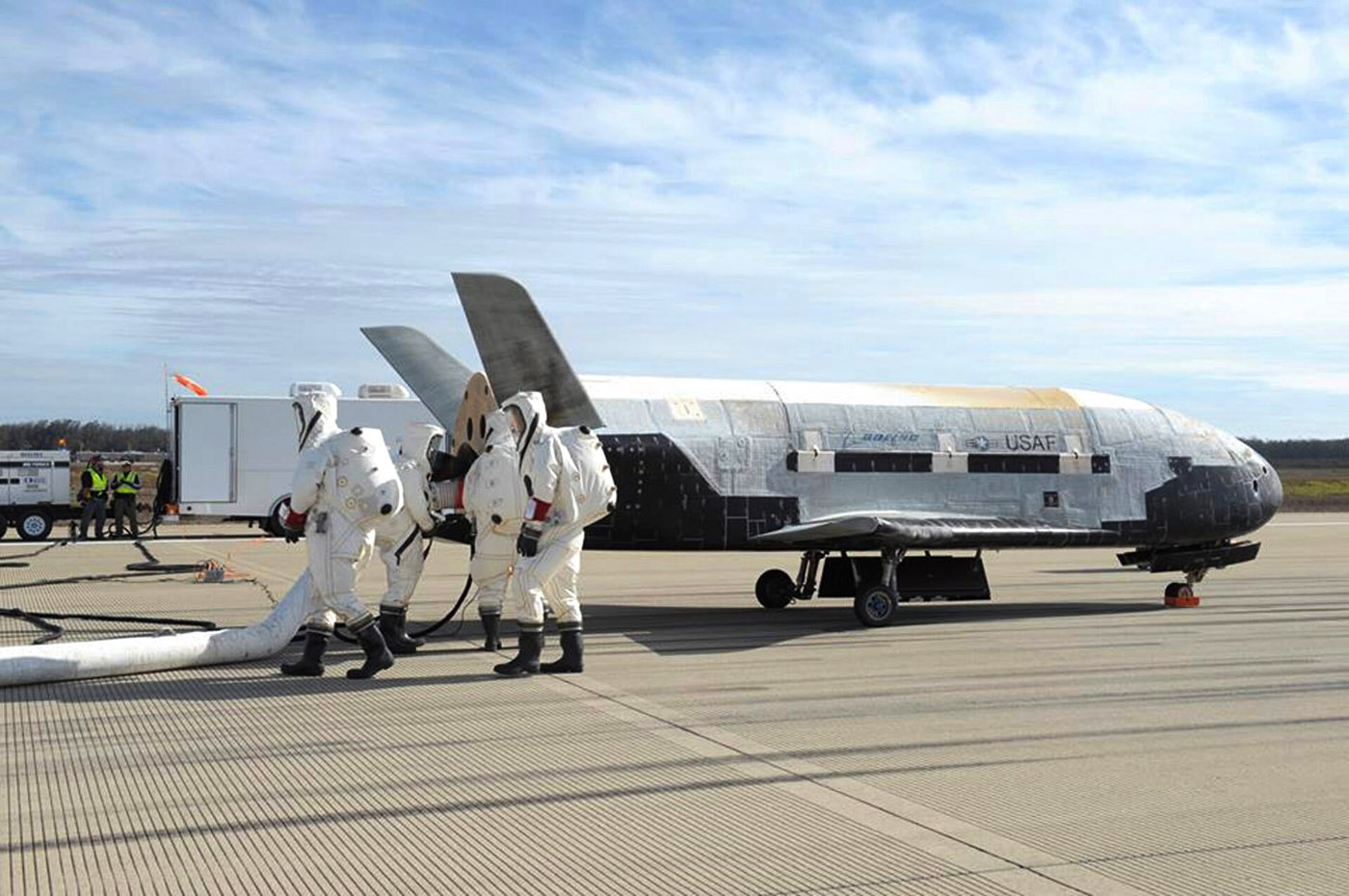 The X-37B Orbital Test Vehicle mission 3 space plane is shown after landing at Vandenberg Air Force Base, California October 17, 2014. (Image Credit: Boeing/Vandenberg Air Force Base/via Reuters)
Strategic Implications: Technology as Deterrence
The significance of the X-37B extends far beyond its technical specifications. Its ongoing missions demonstrate three critical aspects of U.S. strategy in the space domain:
1. Operational Resilience: By diversifying communications and navigation systems, the U.S. reduces vulnerability to adversary disruption.
2. Technological Superiority: By testing experimental systems in orbit, the U.S. accelerates the path from concept to operational deployment.
3. Deterrence Signaling: The secrecy surrounding payloads enhances strategic ambiguity, complicating adversary planning and reinforcing U.S. deterrence.
AFRCO Acting Director William Blauser said, “OTV-8 exemplifies the X-37B's status as the U.S. Space Force's premier test platform for the critical space technologies of tomorrow. Through its mission-focused innovation, the X-37B continues to redefine the art of the possible in the final frontier of space.”
The X-37B and the Next Era of Space Operations
With OTV-8, the X-37B continues to solidify its role as the premier U.S. platform for testing the technologies of tomorrow. Its combination of reusability, autonomy, and adaptability makes it unlike any other spacecraft in operation. More importantly, it serves as a strategic enabler, ensuring that the United States remains prepared for the challenges of a contested space environment.
As great-power competition expands into orbit, the X-37B’s capabilities embody the U.S. commitment to remain at the forefront of space operations, not only defending existing systems but shaping the rules of the next era of space conflict and cooperation.
While much about its payloads and objectives will remain undisclosed, the significance of the X-37B is clear: it is redefining what is possible in space operations, pushing the boundaries of technology while reinforcing the resilience of U.S. space power.
 The U.S. Air Force's X-37B Orbital Test Vehicle mission 4 after landing at NASA's Kennedy Space Center Shuttle Landing Facility in Cape Canaveral, Florida, U.S., on May 7, 2017. (Image Credit: U.S. Air Force)
ALSO READ:
 Russia-Ukraine War
 Inside the Largest BVR Aerial Combat
Regions




Issues