








Inside China’s Largest Military Parade: Hypersonic Missiles, Drones, and Advanced Defense Systems
IRIA Staff - September 8, 2025
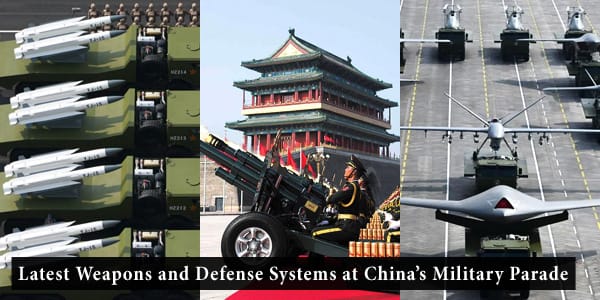
In a powerful display of its rapidly modernizing military, China unveiled a broad spectrum of next-generation weapons systems during a grand military parade commemorating the 80th anniversary of Japan’s surrender and the end of World War II.
The military parade, held in Beijing on September 3, 2025, featured more than 10,000 troops, over 100 aircraft, and hundreds of ground vehicles. The event marked a strategic inflection point for the People’s Liberation Army (PLA), highlighting an array of newly developed platforms and technologies developed to enhance Beijing’s deterrence, precision strike, and unmanned warfare capabilities.
From hypersonic missiles and stealth fighters to anti-ship missiles and advanced unmanned systems, as well as directed-energy weapons and robot dogs, the parade emphasized not only China’s hardware innovation but also its integration of multi-domain, AI-driven warfare concepts.
The ceremony brought together high-profile foreign dignitaries. With Russian President Vladimir Putin and North Korean leader Kim Jong Un among the guests of honor, the display was as much a demonstration of Beijing’s military progress as it was a carefully orchestrated message about China’s role in shaping a new world order.
Grand Display of China’s Military Strength
More than 50,000 people filled Tiananmen Square in Beijing, where Chinese President Xi Jinping presided over a massive show of military hardware. Thousands of Chinese troops paid guard of honor in precise formations, accompanied by tanks, armored vehicles, and state-of-the-art missile systems.
Overhead, a fleet of fighter jets and bombers roared through Beijing’s skies, performing flyovers that drew applause from invited audiences. The parade highlighted a wide range of advanced systems, including hypersonic missiles, stealth drones, and modernized naval strike capabilities.
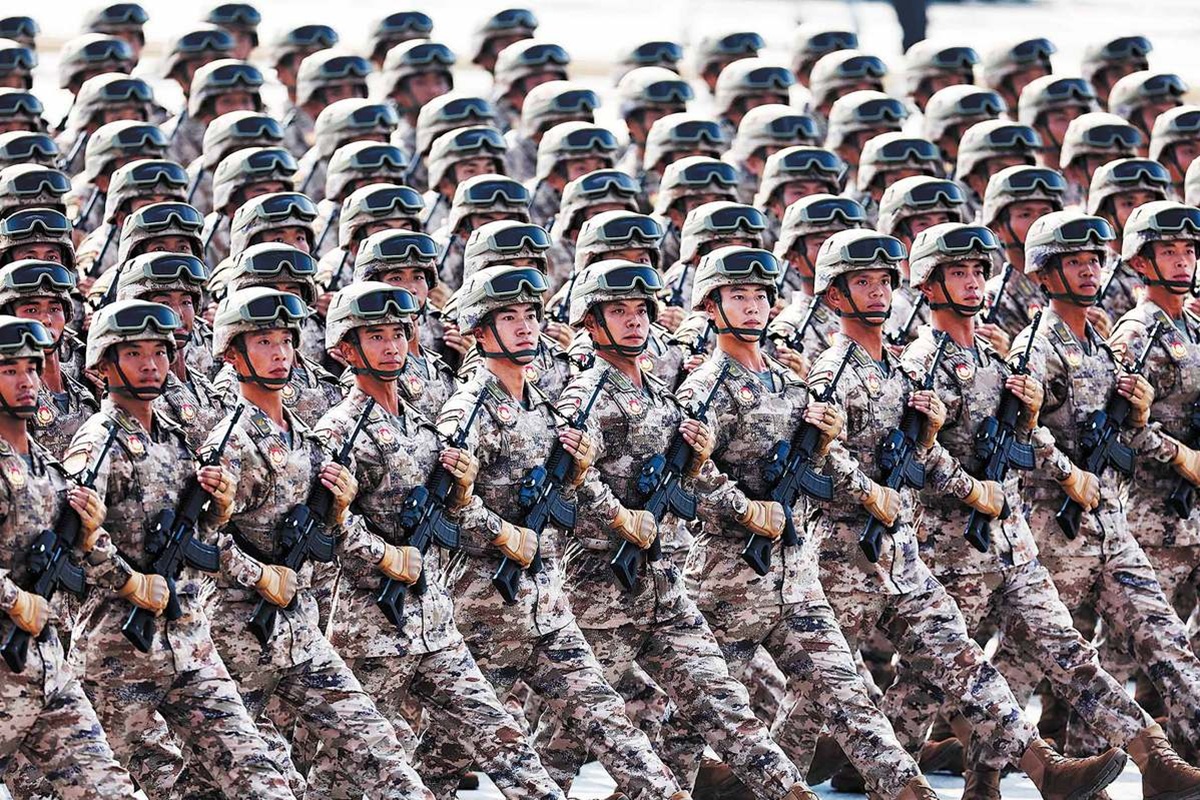 China's People's Liberation Army's Cyberspace Force formation marches during the military parade in Beijing, China, on September 3, 2025. (Image Credit: Xinhua)
Chinese President Xi Jinping, dressed in a grey Mao-style suit, reviewed the troops from an open-top limousine, saluting units as they passed. In his keynote speech, he emphasized both national pride and military readiness.
“Today we honor the heroes who fought to secure peace, but we also show the world that the Chinese people are ready to defend our sovereignty and national security,” Xi declared. His remarks reinforced the dual message of commemoration and deterrence, linking China’s historical sacrifices to its modern strategic ambitions.
China's Hypersonic Missiles, Underwater Drones, and High-Tech Systems
The parade in Beijing was more than a commemoration of past battles; it also demonstrated the future of warfare. This year, the People’s Liberation Army (PLA) revealed a suite of advanced, never-before-seen weapons that highlight Beijing’s drive toward dominance in hypersonic strike capability, unmanned aerial systems, and naval power projection. Many of these systems were shown publicly for the first time, offering insight into China’s evolving military doctrine.
Hypersonic & Supersonic Missiles and ICBMs
China has placed renewed emphasis on hypersonic strike capabilities as a counter to U.S. missile defenses. The parade showcased four new Ying Ji or YJ-series hypersonic missiles, YJ 15, YJ 17, YJ 19, and YJ 20, alongside critical systems like the DF 17, YJ 21, and the DF 26D, highlighting Beijing’s evolving, multi-layered precision-strike doctrine.
DF-5C global range ICBM
A modernized liquid-fueled intercontinental ballistic missile (ICBM) unveiled at the 2025 V Day parade was DF-5C, which features a global strike range exceeding 20,000 km. It is transported in three parts for faster launch readiness, and can carry multiple independently targetable warheads (MIRVs) or decoys. It employs advanced guidance systems (inertial, stellar, and BeiDou satellite navigation) to enhance precision and penetration ability.
• Role: Nuclear second-strike deterrence with rapid response and global reach.
• Capabilities: Global coverage, segmented transport for swift readiness, MIRV capability, and cutting-edge guidance tech.
Based on the latest parade footage, China now has nine distinct variants of land-based ICBMs: DF-5A, DF-5B, DF-5C, DF-27 (not yet publicly displayed), DF-31A, DF-31AG, DF-31BJ, DF-41, and DF-61.
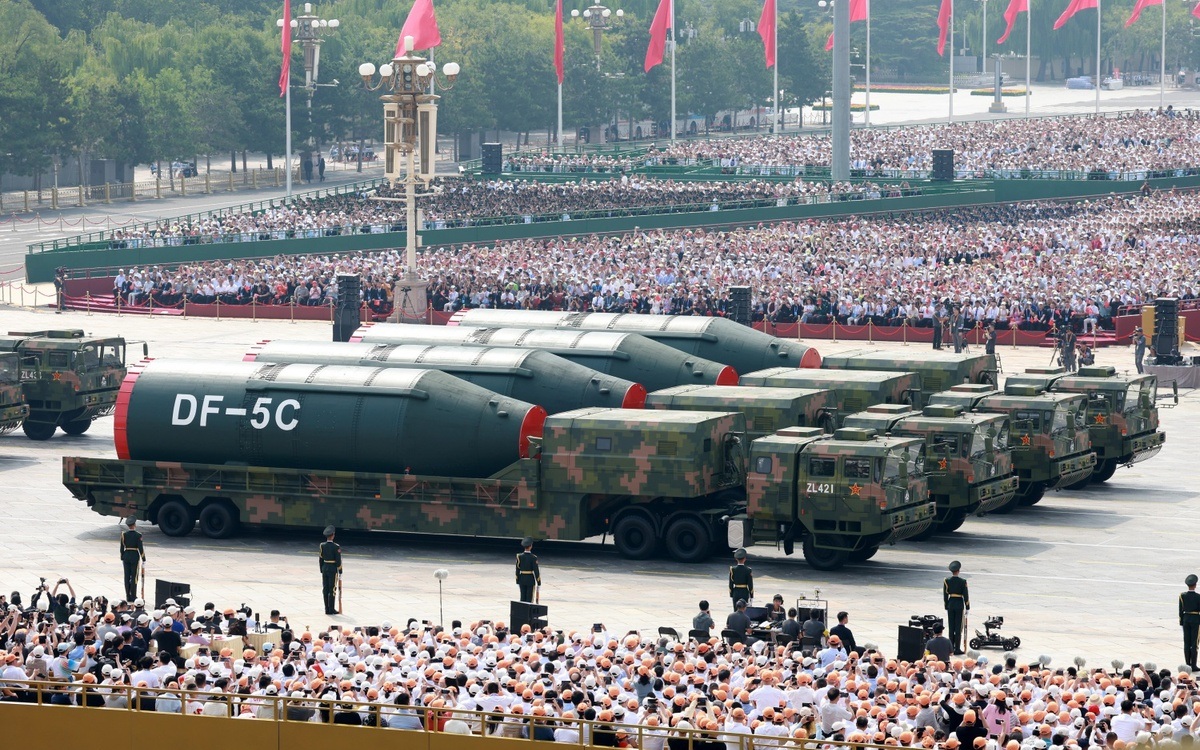 China's liquid-fueled intercontinental strategic nuclear missiles DongFeng-5C (DF-5C) unveiled at the Tiananmen Square during the V-Day military parade in Beijing on September 3, 2025. (Image Credit: China Daily/Feng Yongbin)
DF 61 and DF 31BJ ICBMs
DF 61 (DongFeng-61) is a newly unveiled, solid-fueled, road-mobile ICBM that uses a 16-wheeled transporter-erector-launcher (TEL) nearly identical to that of the DF 41 and is believed to serve as a successor or complement to the DF 41 system.
DF 31BJ is a silo-based variant of China’s solid-fuel DF 31 ICBM family. Together, these systems bolster the survivability and flexibility of China’s second-strike nuclear forces, mixing the mobility of road-mobile systems with the hardened realism of silo deployment.
YJ-15 Supersonic Anti-Ship Missile
A compact, ramjet-powered weapon, the YJ-15 is designed for both air and ship launch. The YJ-15 is smaller and more streamlined compared to China’s newer hypersonic missiles, allowing multiple missiles to be carried per platform, especially by carrier-based J-15 fighters. It is capable of supersonic speeds, making it suitable for saturation attacks against large naval formations such as U.S. carrier groups, complicating their defense.
• Launch Platforms: J-15 carrier-based fighters, destroyer vertical launch systems (VLS) with booster.
• Role: High-speed supersonic anti-ship strikes.
• Significance: First public appearance at the 2025 V-Day parade enables mass missile attacks with a smaller, versatile missile complement, enhancing China’s naval strike capabilities
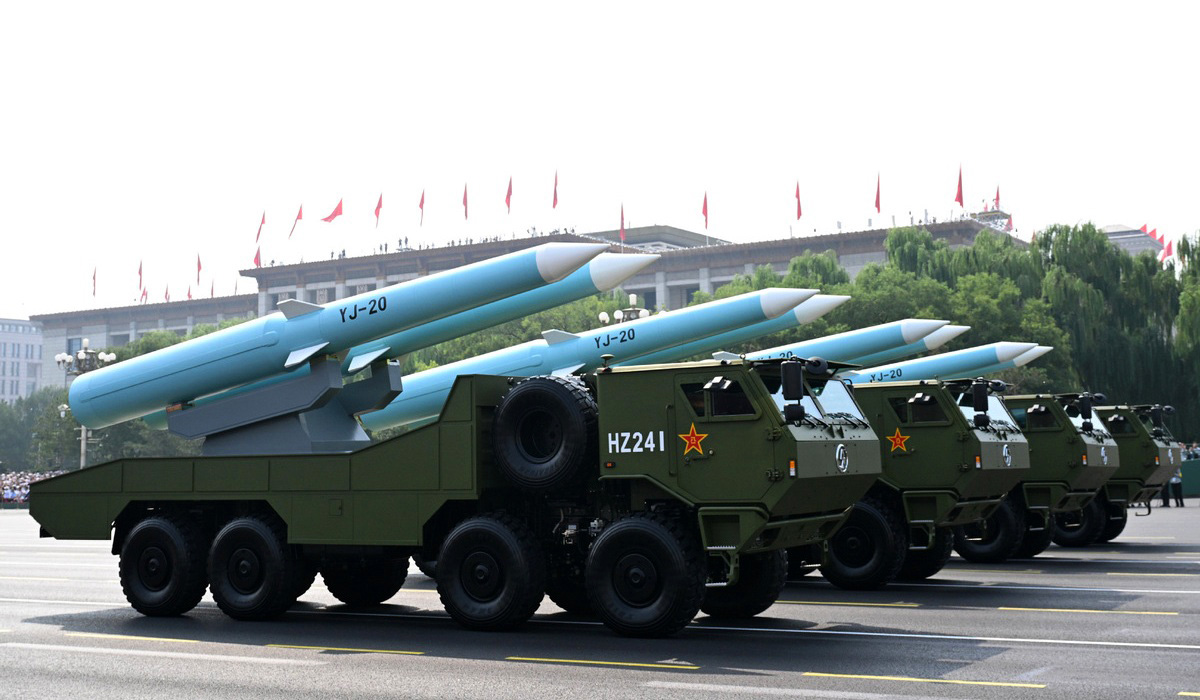 China's hypersonic anti-ship missiles, including YingJi-15, YingJi-19, YingJi-17 and YingJi-20, passed through Tian'anmen Square during the military parade in Beijing, China, on September 3, 2025. (Image Credit: Xinhua)
YJ-17 Hypersonic Glide Missile
The YJ-17 is a boost-glide hypersonic missile that combines a ballistic booster with a maneuverable hypersonic glide vehicle. This configuration allows the missile to execute flexible trajectory changes during flight, making its path highly unpredictable and difficult to intercept. Designed to fit into universal VLS cells, the YJ-17 can be deployed from most modern Chinese Navy (PLAN) destroyers.
• Role: Long-range, high-speed strike against ships and potentially land targets.
• Feature: Boost-glide design with a maneuverable hypersonic glide vehicle, increasing penetration capability against missile defenses.
YJ-19 Hypersonic Cruise Missile
The YJ-19 is China’s first air-breathing hypersonic cruise missile, introduced during the 2025 Victory Day military parade. Powered by a scramjet engine, it is capable of sustained hypersonic flight at speeds exceeding Mach 5. The missile can be launched from various platforms, including strategic bombers, surface vessels, and submarines, enhancing its versatility and strike range. YJ-19’s introduction marks a significant advancement in China's missile technology, offering enhanced speed, range, and maneuverability.
• Speed: Capable of reaching speeds above Mach 5, with potential to exceed Mach 10.
• Launch Platforms: H-6 bombers, submarine torpedo tubes.
• Role: Long-range anti-ship and land-attack capabilities.
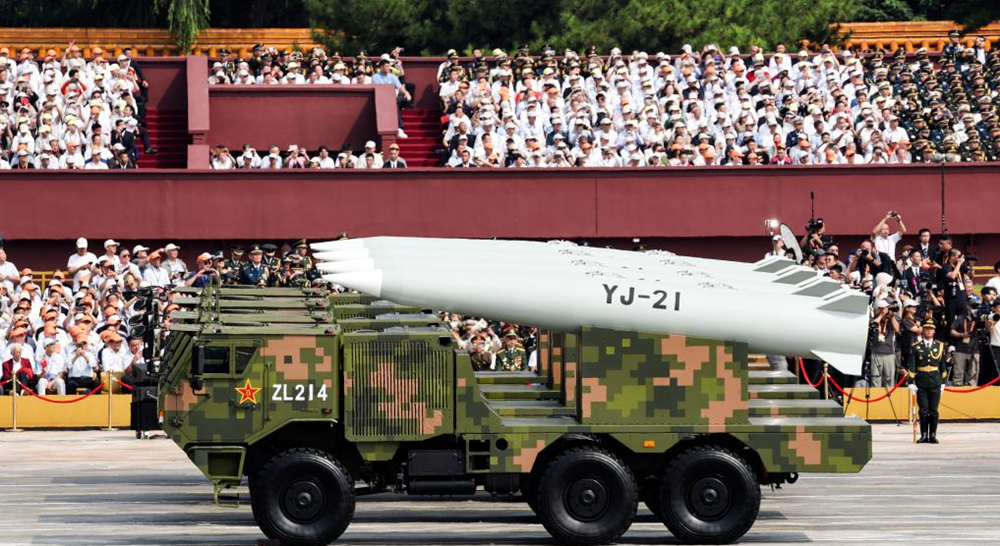 The hypersonic missile formation attends a military parade in Beijing, China, Sept. 3, 2025. (Image Credit: Xinhua/Zhang Tao)
YJ-20 Hypersonic Ballistic Missile
The YJ-20 is a large, hypersonic anti-ship ballistic missile featuring a biconic aerodynamic design, combining the brute force of a traditional ballistic missile with the maneuverability of a hypersonic glide vehicle. Its versatility allows both anti-ship and ground attack roles. The YJ-20 is primarily intended for anti-ship operations, capable of striking large surface vessels at extended ranges. Its high speed and maneuverability make it a formidable weapon against modern naval assets.
• Speed: Hypersonic, exceeding Mach 5
• Launch Platforms: Designed for deployment from large surface vessels, such as the Type 055 Renhai-class destroyers, utilizing VLS.
• Role: Anti-ship strike with enhanced penetration capabilities.
CJ-1000 Hypersonic Cruise Missile
One of the most striking debuts at the parade was the CJ-1000 is an air-launched strategic hypersonic missile which enhances China’s strategic strike capability. It is larger and potentially faster than comparable U.S. systems like the AGM-183 ARRW, designed for penetrating advanced missile defenses.
• Role: Long-range precision strikes against heavily defended land targets and naval forces.
• Strategic Impact: Part of a layered missile doctrine combining tactical, intermediate, and strategic hypersonic systems to challenge U.S. naval and global power projection.
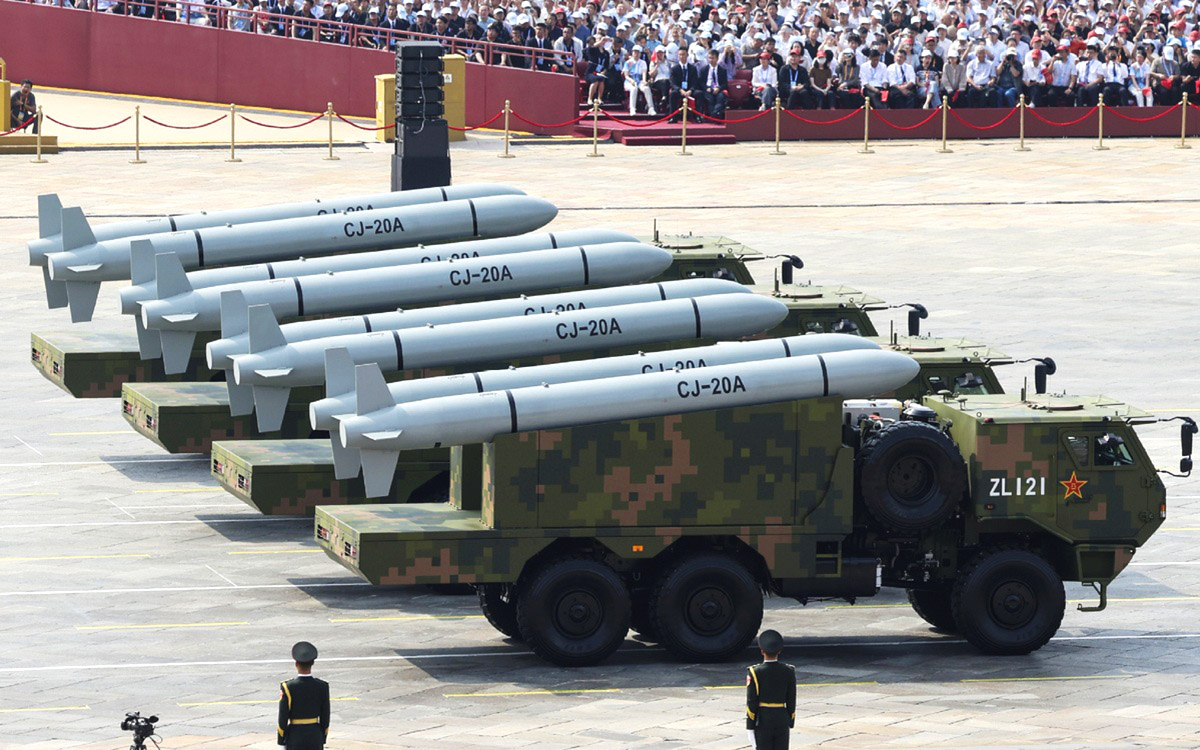 China's cruise missile formation attends the military parade with ChangJian-20A (CJ-20A) missiles in Beijing, China, on September 3, 2025. (Image Credit: Xinhua)
DF-17 Hypersonic Glide Missile
A medium-range ballistic missile equipped with a hypersonic glide vehicle, the DF-17 (DongFeng-17) offers high speed and maneuverability to evade missile defenses. It is designed primarily for rapid, precise strikes against land targets and large sea vessels.
• Role: Tactical and regional strikes against land and maritime targets.
• Launch Platforms: Road-mobile ballistic missile launcher.
• Significance: China’s first operational boost-glide hypersonic weapon, enhancing strike unpredictability.
DF-26 Hypersonic Ballistic Missile
A dual-capable ballistic missile with quasi-hypersonic speeds, the DF-26 can strike both land bases and moving ships at medium to long ranges. Its maneuverability complicates interception by enemy defenses. The DF-26 intermediate-range ballistic missile is also known as the “Guam killer” because of its range to reach the U.S. Island territory.
• Role: Anti-ship and land attack, including strategic targets like U.S. bases in the Pacific.
• Launch Platforms: Road-mobile ballistic missile launcher.
• Significance: It extends China’s anti-access/area denial (A2/AD) capabilities.
Together, these hypersonic weapons demonstrate a layered doctrine: tactical systems like the YJ-15 for saturation attacks, intermediate systems like the YJ-17 and YJ-19 for flexible launches, and strategic systems like the CJ-1000 for deep strikes. This reflects Beijing’s intent to neutralize U.S. naval power projection and secure credible global strike options.
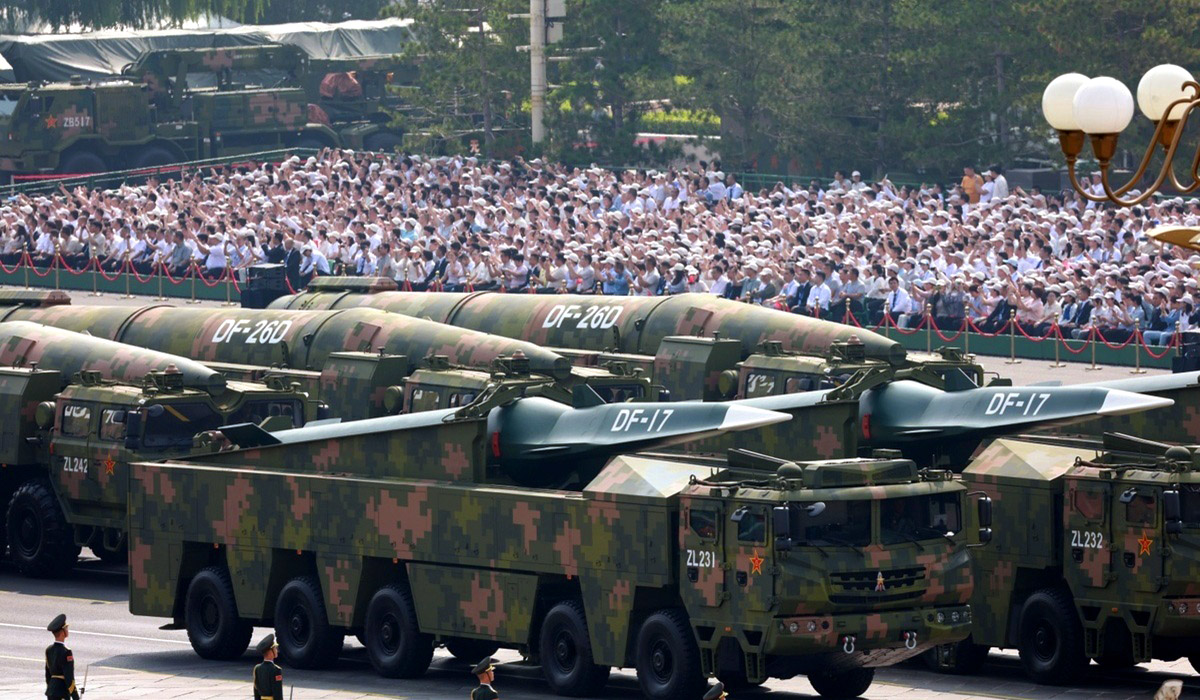 China's DongFeng-17 (DF-17) and DongFeng-26D (DF-26D) hypersonic missiles are seen during the military parade in Beijing, China, on September 3, 2025. (Image Credit: China Daily/Feng Yongbin)
Aerial Systems
China’s advances in the air domain were equally striking. The parade featured multiple types of drones, unmanned fighter jets, stealth bombers, UAV helicopters, and next-generation manned aircraft. The aviation segment of the parade was dominated by designs for loyal wingman and collaborative combat aircraft roles.
Unmanned Combat Drones
China debuted a range of new armed reconnaissance, wingman, and air superiority drones. These systems are capable of stealth operations, wide-area coverage, and autonomous collaboration, offering a glimpse into future AI-assisted air combat. Some are designed to act as loyal wingmen for aircraft like the J-20, extending sensor reach and combat punch. These drones, featuring stealth strikes, ISR (intelligence, surveillance, and reconnaissance), and electronic warfare, highlight China’s emphasis on autonomous warfare and manned-unmanned teaming.
GJ-21 and GJ-11 Stealth Drones
The parade also showcased upgraded GJ-series stealth drones, including the GJ-11 and GJ-21. These subsonic strike UAVs are optimized for stealth and have been adapted for carrier operations, confirming their integration with naval air wings. Their primary role is to conduct precision strikes against ground and maritime targets. They can be compared conceptually to the U.S. Navy’s X-47B and Europe’s nEUROn drones.
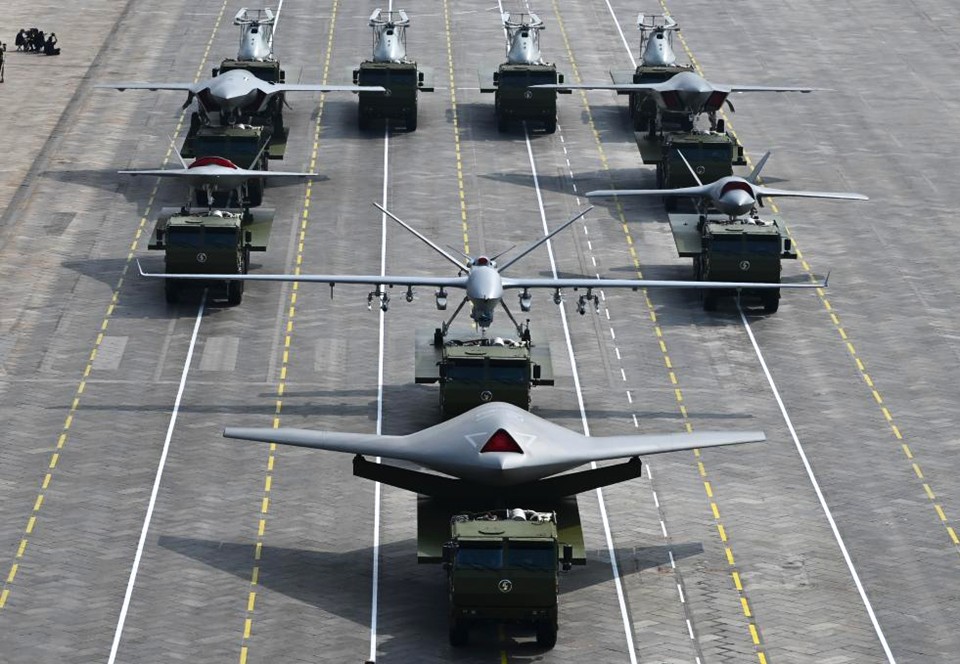 China's airborne unmanned warfare formation at the grand military parade in Beijing, China, on September 3, 2025. (Image Credit: Xinhua/Zhang Cheng)
Shipborne Unmanned Helicopter
China showcased a shipborne unmanned helicopter, designed for reconnaissance and anti-submarine warfare (ASW). The rotorcraft drone, roughly the size of a Bell 407, has a compact, modular design that suggests flexibility across multiple ship classes.
JL-1 ALBM
JL-1 (JingLei-1) nuclear-capable air-launched ballistic missile (ALBM) was unveiled for the first time at 2025 parade, marking China’s progress in airborne nuclear strike options. Designed to be launched from strategic bombers such as the H-6, the JL-1 enhances China’s ability to deliver precise, rapid-response strikes from the air domain.
Integrating the JL-1 into the nuclear triad provides greater operational flexibility and complicates enemy missile defense efforts by diversifying China’s nuclear delivery platforms.
KJ-600 Carrier AWACS Aircraft
The twin-propeller KJ-600, which debuted at the parade, is China’s answer to the U.S. E-2D Hawkeye, providing carrier groups with long-range radar coverage and airborne battle management. China’s first carrier-based AWACS KJ-600 is purpose-built for the Type 003 Fujian carrier. Its introduction fills a crucial gap in China’s blue water naval operations.
Together, these platforms demonstrate China’s push toward a networked, integrated air warfare force, combining stealth, unmanned systems, and airborne command assets. This would allow PLA to overwhelm adversaries not through brute force alone, but via orchestrated, multi-domain coordination.
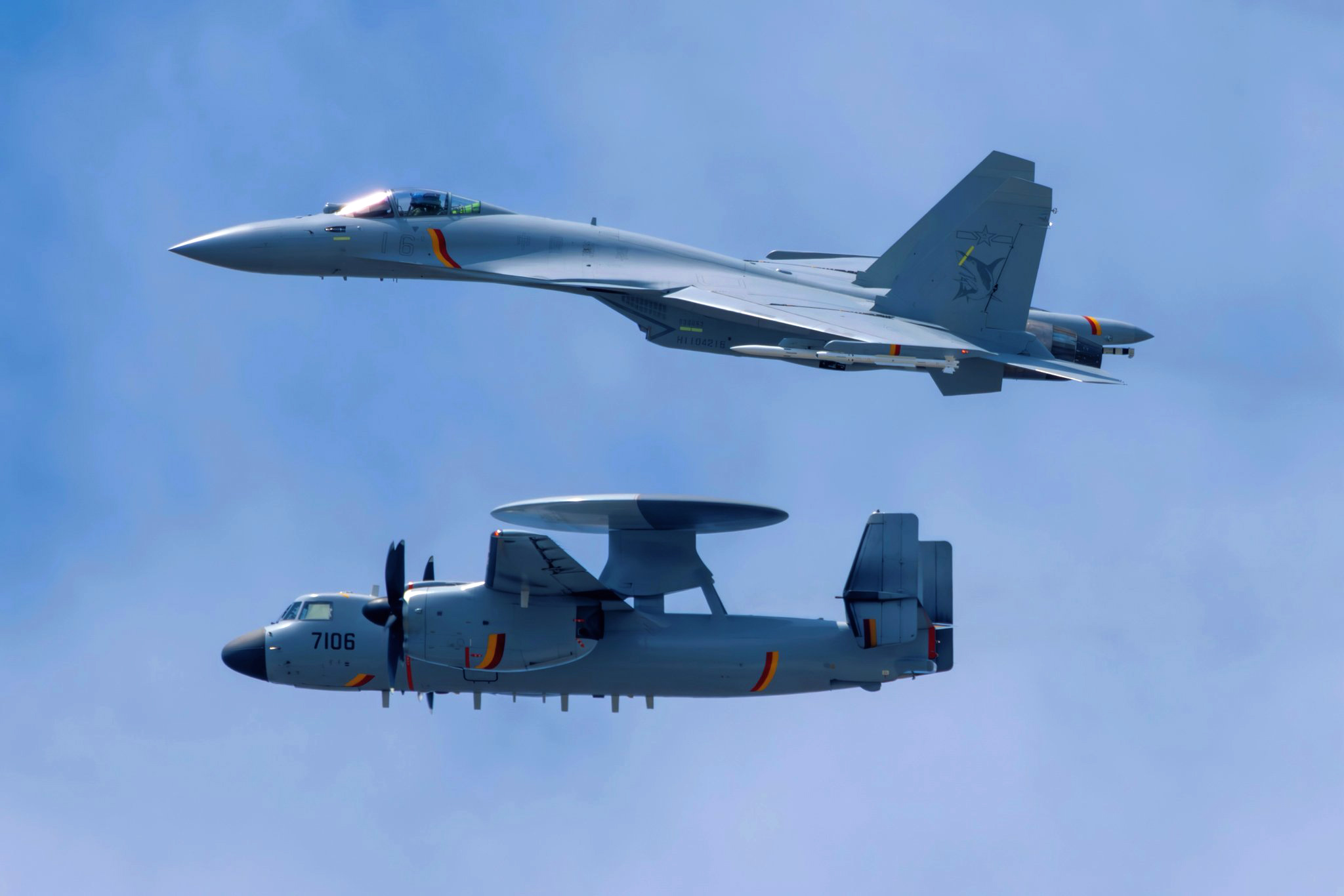 China's PLAN carrier-based AEW&C aircraft with J-15 jet. (Image Credit: X/@FaySue6)
Fighter Jets
China’s expanding fifth-generation airpower was on full display during the parade, with formations led by the J-20 stealth fighter and J-16D electronic warfare aircraft, joined by carrier-based J-15s and the newly debuted J-35A.
J-20S Two-Seat Stealth Fighter
The debut of the J-20S underscores a profound shift in China’s aerial doctrine. As the world’s first two-seat fifth-generation stealth fighter, it enables a dedicated mission systems officer in the second crew position, tasked with managing unmanned wingmen or orchestrating weapon systems, while the pilot in the front seat focuses entirely on flight operations. This structure paves the way for fully integrated manned-unmanned teaming in high-intensity aerial combat environments.
J-35A Carrier Stealth Fighter
China also introduced the J-35A, a new-generation stealth fighter designed specifically for carrier operations. This aircraft is expected to replace the older J-15, significantly enhancing the stealth strike capability of China’s naval air wings.
The introduction of J-20 and J-35 highlights how the People’s Liberation Army Air Force (PLAAF) and PLAN are undergoing a systemic transformation centered on stealth technology and advanced interoperability.
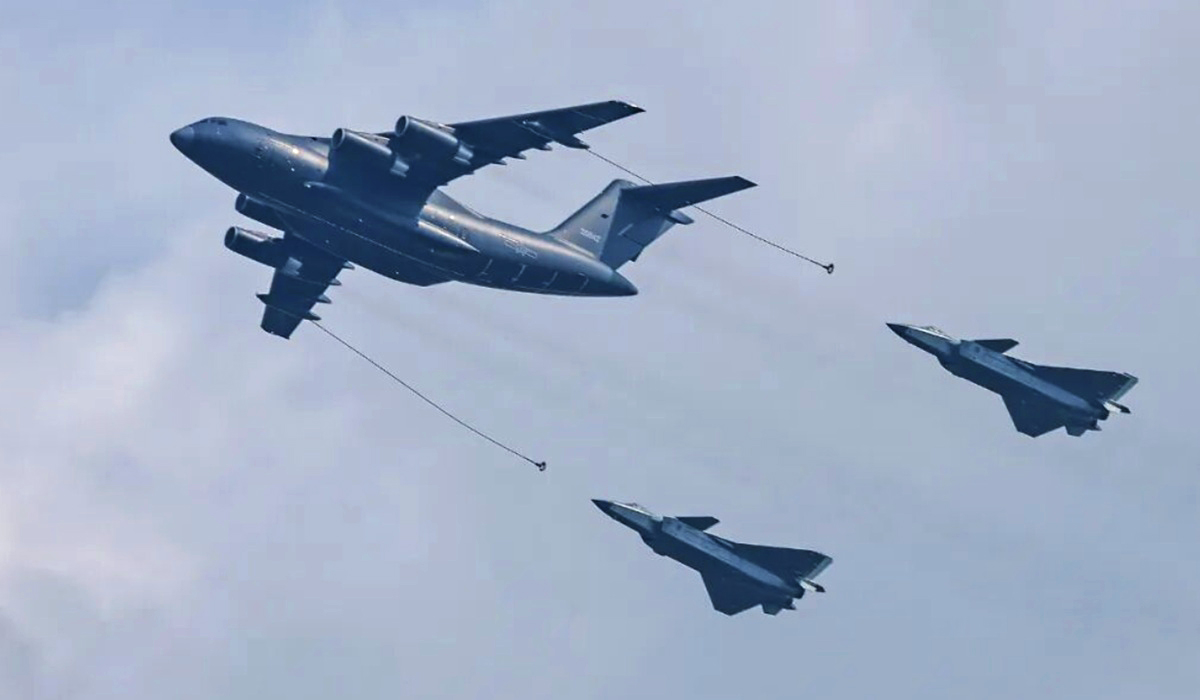 Y-20A shows its refueling capabilities with a J-16 and a J-20 jet during the rehearsal of the aerial part of the military Victory-day parade. (Image Credit: X/@yicaichina)
Naval and Maritime Systems
China’s military parade also emphasized maritime dominance, unveiling new undersea drones, unmanned submarines, and directed-energy defenses. China displayed a new autonomous unmanned underwater vehicle (UUV) capable of covert reconnaissance, mine-laying, and swarm operations. It underscores China’s investment in unmanned maritime warfare and anti-access strategies.
JL-3 SLBM
The JL-3 (JuLang-3) submarine-launched ballistic missile (SLBM), unveiled at the 2025 parade, marks a significant advancement in China’s sea-based nuclear deterrent capabilities. With a range exceeding 8,000–10,000 kilometers, the JL-3 allows China’s nuclear submarines to maintain second-strike capability from within coastal waters, without needing to sail into deep oceans.
The JL-3 is deployed aboard Type 094A submarines and is intended for the next-generation Type 096 (nuclear ballistic missile submarines) SSBNs, extending China’s sea-based nuclear reach through stealthy, survivable patrols with global strike capability.
AQS-003A AUV
The AQS-003A autonomous underwater vehicle (AUV) displayed during China’s military parade, designed to be launched from submarine torpedo tubes. It can independently identify and engage targets, enhancing China’s undersea warfare by enabling flexible, covert mine-laying from submarines, ships, or aircraft. This system reflects China’s push to modernize its naval capabilities with advanced unmanned technologies.
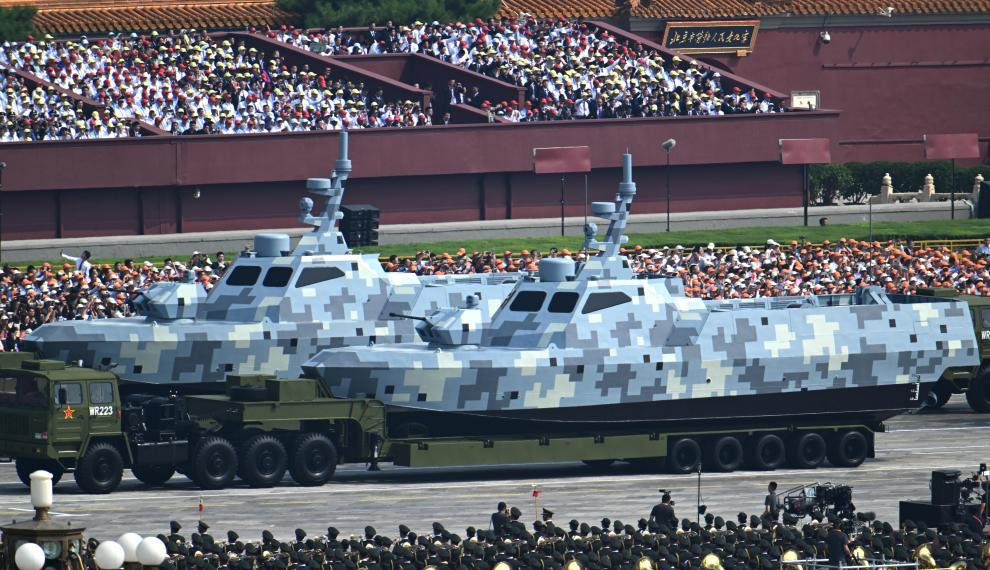 China's sea-based unmanned warfare formation at the military parade in Beijing, China, on September 3, 2025. (Image Credit: Xinhua/Deng Hua)
AJX002 XLUUV
The AJX 002 extra large unmanned underwater vehicle (XLUUV), measuring approximately 18-20 meters in length and 1-1.5 meters in diameter, was showcased atop transport vehicles during the parade. Featuring a torpedo-like hull, pump-jet propulsion, and lifting lugs for crane deployment, this unmanned underwater vehicle is likely modular for ease of transport. At least four AJX 002 units appeared alongside two larger variants, signaling a substantial XLUUV program.
• Role: Reconnaissance, mine-laying, or special missions.
• Comparison: Similar in concept to the U.S. Boeing Orca XLUUV program.
• Significance: Expands PLAN’s ability to operate covertly in contested waters.
LY-1 Shipborne Laser
The LY-1 high-power laser weapon system made its first public appearance as part of a multi-tier shipborne air defense system. Installed aboard larger PLAN surface vessels, the 60–100 kW system offers precision, low-cost interception of drones and even anti-ship missiles. Its public debut confirms successful integration with existing naval platforms, underscoring China’s emphasis on directed-energy for layered fleet defense.
Laser and Microwave
China revealed a high-power microwave system designed to neutralize swarming UAVs through electronic disruption. It forms part of an “iron triangle” with missile, artillery and laser weapons for layered counter-drone defense, capable of destroying both soft and hard-kill targets.
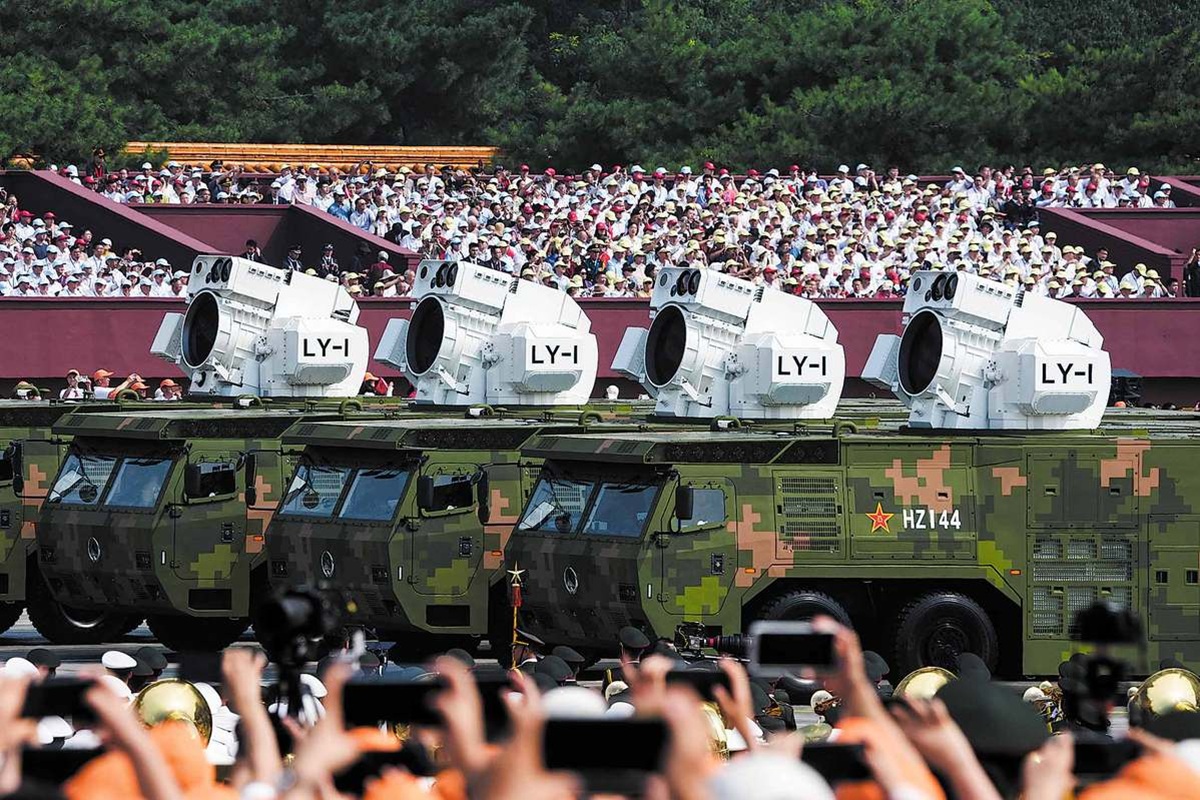 China's ship-based air defense weapons formation is displayed during the military parade in Beijing, China, on September 3, 2025. (Image Credit: Xinhua)
The parade introduced a sophisticated, integrated suite of counter-drone and air defense systems, which included missile artillery units, a shipboard LY 1 laser, and a microwave-based electronic disruption system.
The LY 1 laser stood out for its precision targeting of drones and anti-ship threats at low cost, while the new microwave weapon disables drone swarms by jamming their electronics, demonstrating a layered, multi-domain defense strategy designed to protect the People’s Liberation Army Navy above, below, and at the horizon.
China Showcases its Full Nuclear Triad
China displayed the full spectrum of its nuclear triad of weapons that can be deployed from land, sea, and air for the first time during a major military parade, marking a significant milestone in its military modernization.
This included an upgraded version of the DF-5C ICBM, capable of carrying multiple warheads to global targets, JL-1 ALBM, China’s most advanced SLBM JL-3, as well as both the DF-61 and new DF-31 (DongFeng-31) ICBMs. Together, these systems mark a major step toward a more survivable second-strike capability, reinforcing Beijing’s long-standing “no first use” doctrine.
Hypersonic, supersonic, and autonomous weapons featured at the parade, alongside advanced drone and anti-drone systems that underscored China’s growing focus on unmanned and next-generation warfare. The event marked a structural shift in the PLA, with formations from cyber, information, and aerospace forces on display, highlighting Beijing’s growing focus on digital and multi-domain operations.
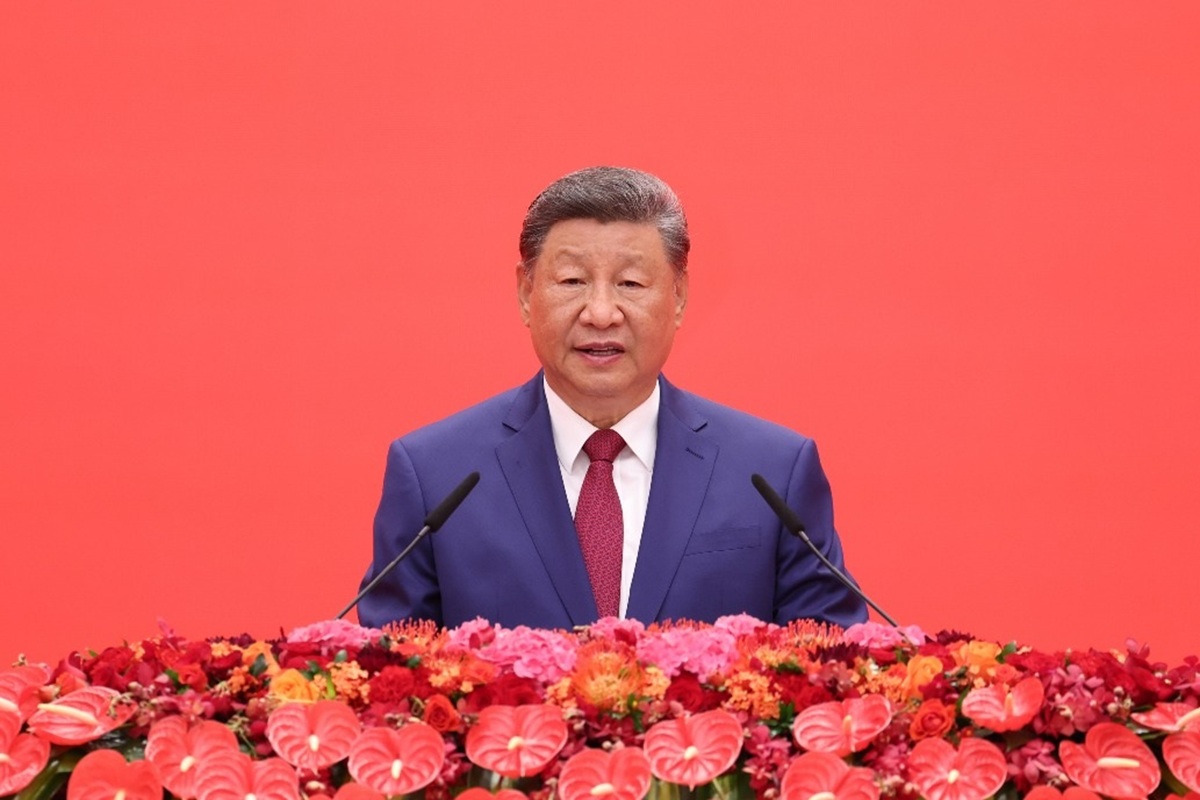 Chinese President Xi Jinping speaking at Victory-day reception address in Beijing, China, on September 3, 2025. (Image Credit: ChinaDaily/Xinhua)
“Peace Must be Defended with Strength”: Xi Jinping
In his speech, Chinese President Xi Jinping sought to frame the parade not as an act of aggression but as a continuation of China’s historical resistance against imperialism and foreign domination.
President Xi invoked the memory of World War II, particularly Japan’s invasion of China, to stress the importance of vigilance and unity. “The Chinese people will never allow history to repeat itself. We stand for peace, but peace must be defended with strength,” Xi said.
The government’s portrayal of the event emphasized themes of national rejuvenation and historical justice. State media outlets framed the parade as both a tribute to the fallen and a necessary reminder to the world that China’s rise is unstoppable.
Documentaries, interviews with veterans, and patriotic songs accompanied coverage of the parade, reinforcing the official narrative that China’s military modernization is defensive in nature and rooted in past struggles.
World Leaders at China’s Victory Day Military Parade
As many as 26 foreign leaders have traveled to China, with some attending the Shanghai Cooperation Organization (SCO), while others arrived for the military parade, signifying China’s strong global partnerships at a time of tense relations with the West.
Russian President Vladimir Putin and North Korean leader Kim Jong Un were the most prominent guests, standing alongside Xi Jinping throughout the ceremony. Kim’s teenage daughter, Kim Ju Ae, made her first known overseas appearance at the event, reinforcing speculation about her role as a potential successor.
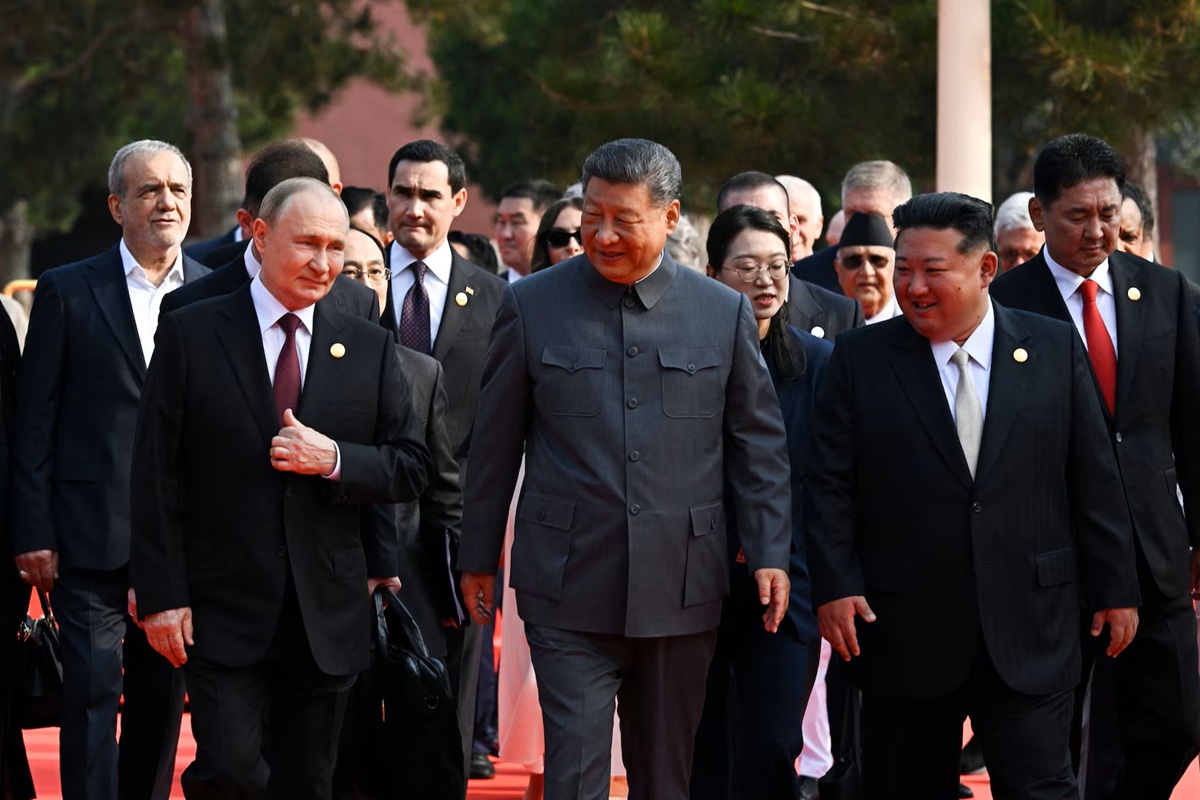 Russian President Vladimir Putin, Chinese President Xi Jinping, North Korean leader Kim Jong Un and heads of foreign delegations arrive for the military parade marking the 80th anniversary of the end of World War Two, in Beijing, China September 3, 2025. (Image Credit: Sputnik)
The presence of Kim and Putin at China’s grand parade highlighted the deepening alignment between Beijing, Moscow, and Pyongyang in the face of growing confrontation with the West. Putin, seated next to Xi, was warmly received and later escorted in an armored limousine by the Chinese leader. The gesture symbolized a tightening partnership at a time when Russia is increasingly isolated due to its ongoing war in Ukraine.
Kim Jong Un was given special prominence during the event. His attendance marked the first time a North Korean leader had appeared at such a high-profile Chinese military commemoration in decades.
Analysts suggested that the symbolism was clear: China wanted to signal unity with its closest regional ally at a moment of heightened tensions with the United States, Japan, and South Korea. The optics of Xi flanked by Putin and Kim underlined a shifting geopolitical landscape, where China is positioning itself at the center of a new axis challenging Western dominance.
Besides Putin and Kim, Iranian President Masoud Pezeshkian, Belarusian President Alexander Lukashenko,and Myanmar’s Senior General Min Aung Hlaing were among those seated near the front rows. Pakistani Prime Minister Shehbaz Sharif and Mongolian President Khurelsukh Ukhnaa also attended, signaling the depth of China’s partnerships across Asia.
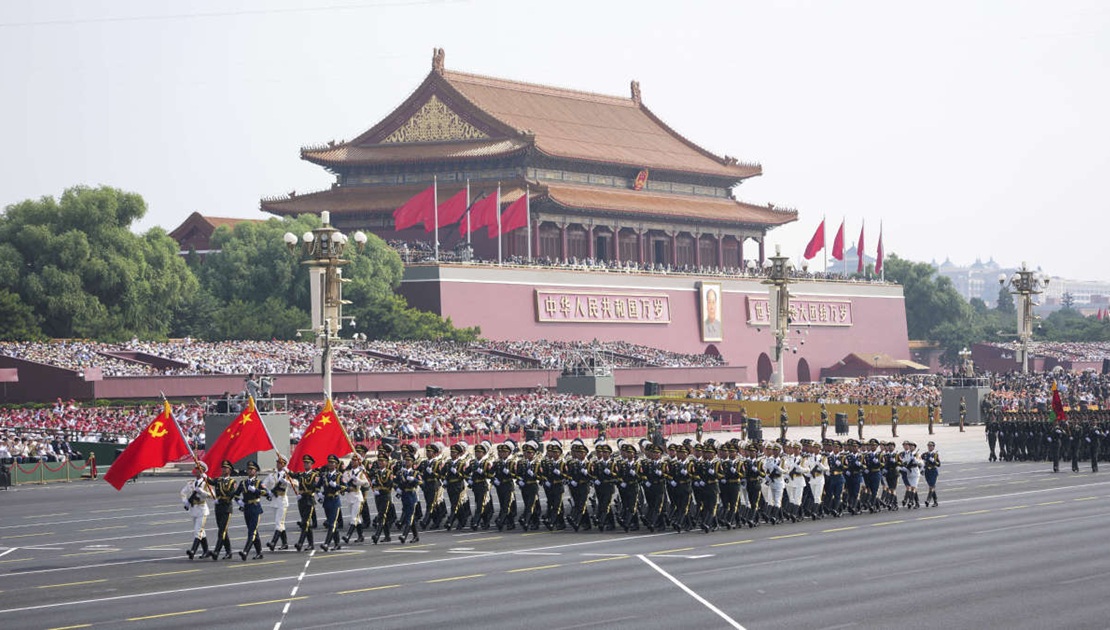 The guard of honor of the Chinese People’s Liberation Army (PLA) at the military parade in Beijing on September 3, 2025. (Image Credit: Xinhua)
From Southeast Asia, Malaysian Prime Minister Anwar Ibrahim, Indonesian President Prabowo Subianto, Vietnamese President Luong Cuong, and Maldives President Mohamed Muizzu were in attendance, reflecting the strong presence of ASEAN leaders. Nepalese Prime Minister KP Sharma Oli and Uzbek President Shavkat Mirziyoyev also joined the commemorations.
African representation came from Zimbabwean President Emmerson Mnangagwa, while Latin America was represented by leaders such as Venezuelan officials aligned with Nicolas Maduro’s government.
Notably, only two European leaders made the trip to Beijing: Slovak Prime Minister Robert Fico and Serbian President Aleksandar Vucic. Their attendance underscored the divide in Europe over relations with China and Russia, with both leaders positioning themselves closer to Moscow and Beijing than to Brussels.
Notable absences were the Indian Prime Minister Narendra Modi and Turkish President Recep Tayyip Erdogan, who had attended the SCO summit days earlier in the nearby city of Tianjin and departed before the parade. Their absence from the Victory Day stage was a subtle but notable signal that both countries balance ties with Beijing while remaining cautious about being too closely aligned with China’s growing bloc.
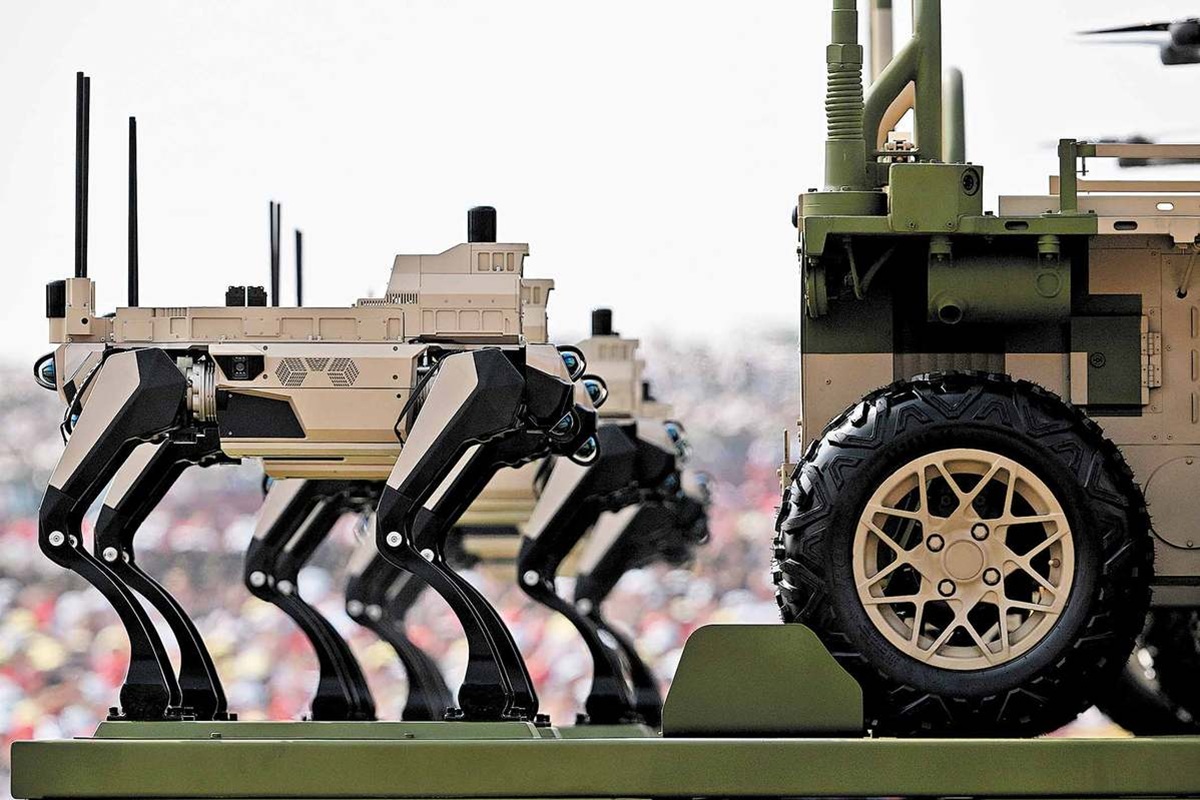 Robot dogs, part of the land-based unmanned warfare formation, are seen during the military parade in Beijing, China, on September 3, 2025. (Image Credit: Xinhua)
ALSO READ:
 China’s Ambitions at Sea and Naval Modernization
 Inside the Largest BVR Aerial Combat
Regions




Issues