


At least 85 Palestinians seeking aid killed in Gaza as Israel expands evacuation orders
Middle East, News July 21, 2025 Comments Off on At least 85 Palestinians seeking aid killed in Gaza as Israel expands evacuation orders6 minute read
At least 85 Palestinians seeking humanitarian aid were killed on July 20, 2025, in one of the deadliest incidents since the start of the war, as Israeli forces allegedly opened fire on crowds gathered near the Zikim aid crossing in northern Gaza.
The incident comes amid a broader escalation, with Israel issuing evacuation orders for parts of central Gaza, one of the last relatively untouched areas by ground operations in the besieged territory.
According to Gaza’s Health Ministry, the death toll on Sunday alone reached 85, with more than 150 others wounded, many in critical condition. The majority were reportedly killed while trying to access aid convoys, further underscoring the desperation of the humanitarian crisis in the Gaza Strip.
The largest number of fatalities occurred in the north, an area devastated by months of fighting and nearly cut off from food, water, and medicine. Zaher Al Waheidi, head of the Health Ministry’s records department, stated that 79 people were killed near the Zikim crossing as they approached aid trucks that had just entered the area.
The UN World Food Program confirmed that 25 trucks had brought supplies for what it described as “starving communities,” but said the situation deteriorated rapidly when massive crowds gathered around them.
A UN official, speaking anonymously due to restrictions on media contact, said Israeli forces opened fire on the crowds attempting to take food from the convoy. Footage reportedly taken by the UN and shared later showed panicked Palestinians fleeing amid sounds of automatic gunfire.
#Gaza: "1 in 10 children is malnourished."
— United Nations Geneva (@UNGeneva) July 19, 2025
Since March, child malnutrition is on the rise when the Israeli near-total aid blockade began. 875 people confirmed dead trying to source food in recent weeks. @JulietteTouma, @UNRWA Director of Communications, briefs the press⤵️ pic.twitter.com/nxlI7GrpiQ
Israel’s military acknowledged the shooting, stating that its troops opened fire on a crowd of thousands it considered a threat, while accusing Hamas of fomenting chaos. However, it claimed the casualty figures provided by Gaza authorities were significantly higher than its preliminary estimates.
In a separate incident, six Palestinians were killed by Israeli gunfire in the Shakoush area near Rafah, not far from a logistics site run by the Gaza Humanitarian Foundation, a joint U.S.- and Israeli-backed initiative. Although the GHF stated it had no reports of violence near its location, local witnesses and health workers claim that hundreds have died while attempting to access aid distributed by or near the GHF.
Further south, in Khan Younis, seven more Palestinians, including a five-year-old boy, were killed by an Israeli strike while sheltering in tents. The Kuwait Specialized Field Hospital received the victims.
Since May 2025, the Israeli forces have killed about 1,000 Palestinians near Gaza Humanitarian Foundation aid distribution sites.
New evacuation orders in central Gaza
In a major development that has heightened fears of a wider ground assault, the Israeli military issued fresh evacuation orders on Sunday for the central city of Deir Al Balah. The directive effectively cuts access between central Gaza and the southern cities of Rafah and Khan Younis — two of the most overcrowded areas due to mass displacement.
Scenes of people hurriedly loading belongings, including live ducks and household goods, onto carts and vehicles were widespread, as smoke from distant bombardments filled the skyline.

The United Nations is now seeking clarification from Israeli authorities about whether their facilities in Deir al-Balah are included in the new evacuation zones. In past operations, U.N. buildings have generally been spared from such orders. Nonetheless, humanitarian access is shrinking by the day.
The Medical Aid for Palestinians (MAP) group stated that several humanitarian offices and guesthouses had been “ordered to evacuate immediately,” with at least nine clinics, including one run by MAP, forced to shut down.
Avichay Adraee, the Israeli military’s Arabic-language spokesman, urged civilians to relocate to the al-Mawasi area on Gaza’s southern coast, a barren stretch of land designated by Israel as a “humanitarian zone” but lacking basic infrastructure and proper shelter.
Mounting civilian toll as ceasefire talks stall
Israel’s Prime Minister Benjamin Netanyahu continues to insist that military pressure will compel Hamas to accept a ceasefire deal, even as indirect talks in Qatar for a 60-day ceasefire and hostage release have yet to yield results. According to Israeli estimates, of the 251 hostages taken during Hamas’s October 7, 2023, attack, 49 remain in Gaza, and at least 27 of those are believed to be dead.
The war began after Hamas militants stormed into southern Israel, killing approximately 1,219 people, most of them civilians, and taking hundreds hostage. In response, Israel launched a full-scale military campaign in Gaza, which has now stretched into its 22nd month.
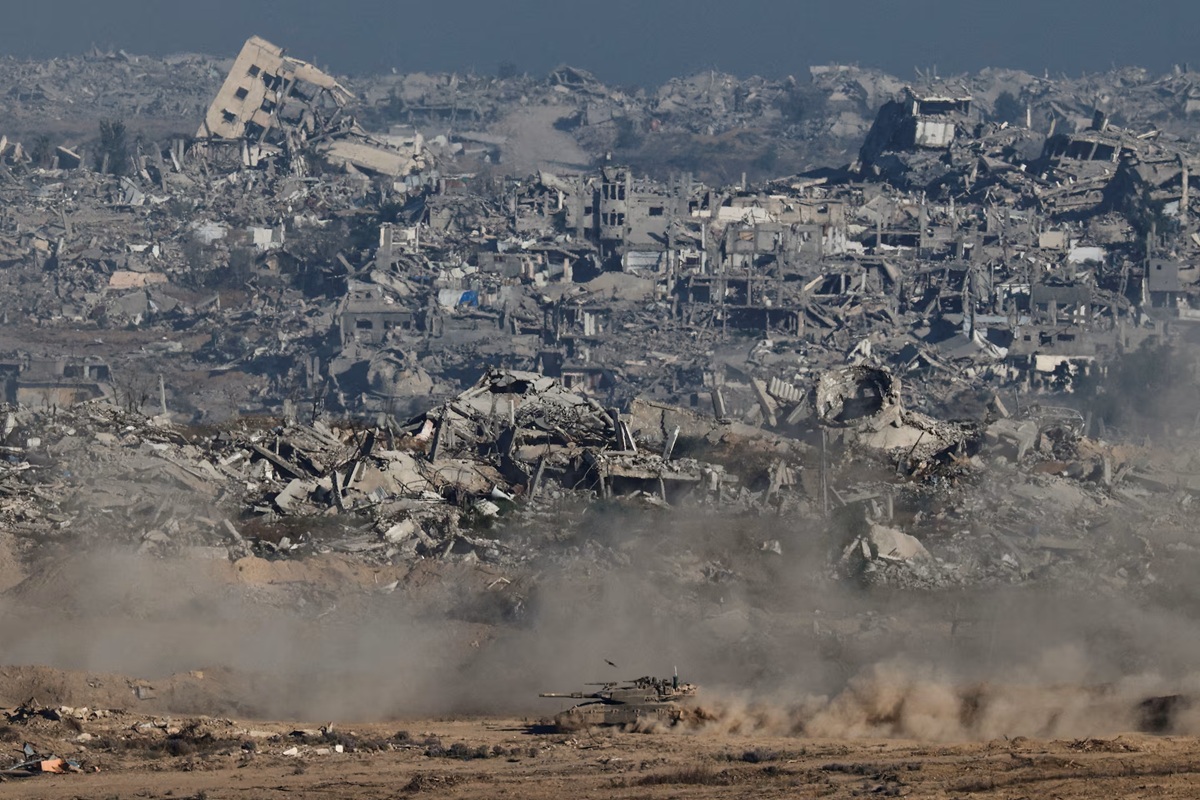
The Palestinian death toll has soared to 58,800, according to Gaza’s Health Ministry, with more than half of those killed being women and children. Civilian infrastructure has been decimated, and over 80% of the territory remains under evacuation orders.

On Sunday, ambulances from three major hospitals blared their alarms in unison in an act of protest and desperation. The Health Ministry shared photos online of medical staff holding signs calling attention to the growing crisis of malnutrition among children and the acute shortage of medications.
Civil society and hostage families demand change
Back in Israel, opposition to the war is mounting. The Hostages Family Forum, a grassroots organization representing families of those still held in Gaza, condemned the new evacuation orders and demanded that the Netanyahu government provide a clear plan for protecting hostages in the face of renewed military activity.
“Enough! The Israeli people overwhelmingly want an end to the fighting and a comprehensive agreement that will return all of the hostages,” the group said in a statement.
On Saturday night, tens of thousands of demonstrators flooded the streets of Tel Aviv, marching from central squares to the branch of the U.S. Embassy and demanding an end to the war.
Ground operations in North Gaza
Meanwhile, Israeli forces intensified their ground operations in northern Gaza, particularly around Jabalia. A military statement claimed that “dozens of terrorists” were killed and “hundreds of terrorist infrastructures” dismantled. It also reported the discovery of a 2.7-kilometer-long underground tunnel network located about 20 meters underground.
Despite these tactical gains, humanitarian conditions continue to worsen. With central Gaza now added to the evacuation map, options for safe shelter are dwindling. Aid groups warn that unless large-scale humanitarian access is restored immediately, starvation, disease, and further mass casualties are inevitable.
Related Articles


IRIA Exclusive




IRIA Publications
Regions






