







Russia's Undersea Strategy and the Changing Nature of Maritime Power
Dr. Yashwant Singh - August 15, 2026
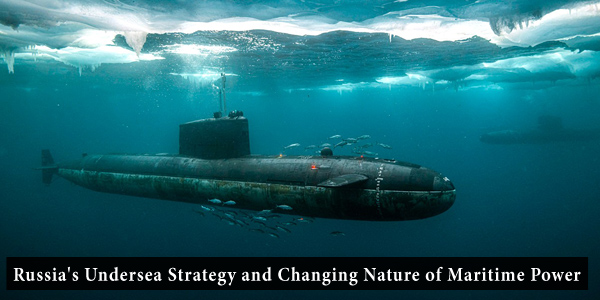
Maritime competition between Russia and the United States has migrated downward, from the fleet actions that defined Cold War rivalry toward a subsurface contest fought across depth, seabed infrastructure, and information networks. Reading this as an attempt to "checkmate" the U.S. Navy would overstate Russian ambition and understate Russian method. Moscow cannot match American carrier aviation, shipbuilding throughput, or defense spending, and it is not trying to. What it has built instead is a set of capabilities that make American naval superiority strategically less decisive, not by defeating it, but by relocating competition to a domain where superiority is harder to define, harder to detect, and harder to attribute. This essay grounds that claim in specific platforms and incidents, then argues that the International Relations theory built to explain territorial, state-bounded competition needs supplementing to explain a domain organized around volume, connectivity, and ambiguity rather than borders and distance.
The Logic of Asymmetric Undersea Competition
Four assumptions underpin Russian undersea investment.
Strategic survivability. The sea-based leg of Russia's nuclear triad depends on SSBNs reaching patrol areas undetected. Arctic "bastion" defense, with key aspects like under-ice operations, seabed sensor networks and anti-submarine denial, exists to protect that force, since a detectable deterrent is a much weaker deterrent.
Infrastructure as a target class. Rather than treating the seabed as empty terrain beneath naval competition, Russian doctrine and procurement treat it as an operational space in its own right: cables, pipelines, and sensor networks are objects of direct interest, not incidental to fleet movement.
Cost imposition through ambiguity. Where Cold War competition often meant matching capability for capability, the more strategically efficient approach is to field platforms whose functions are deliberately unclear: is this a research mission or a reconnaissance operation, a survey or a rehearsal for sabotage? That ambiguity is not a side effect; it is close to the point, since it forces expensive defensive investment without ever crossing a line clear enough to justify retaliation.
Dual-use capability as strategic leverage. Russian undersea investment consistently favors platforms and technologies that can perform both civilian and military functions. Oceanographic research vessels, deep-sea submersibles, seabed mapping systems, and support ships generate scientific and commercial value in peacetime while simultaneously collecting military intelligence, preparing the seabed for future operations, or supporting special missions. This dual-use character complicates attribution, provides plausible deniability, and allows capabilities to be developed and deployed without appearing overtly escalatory.
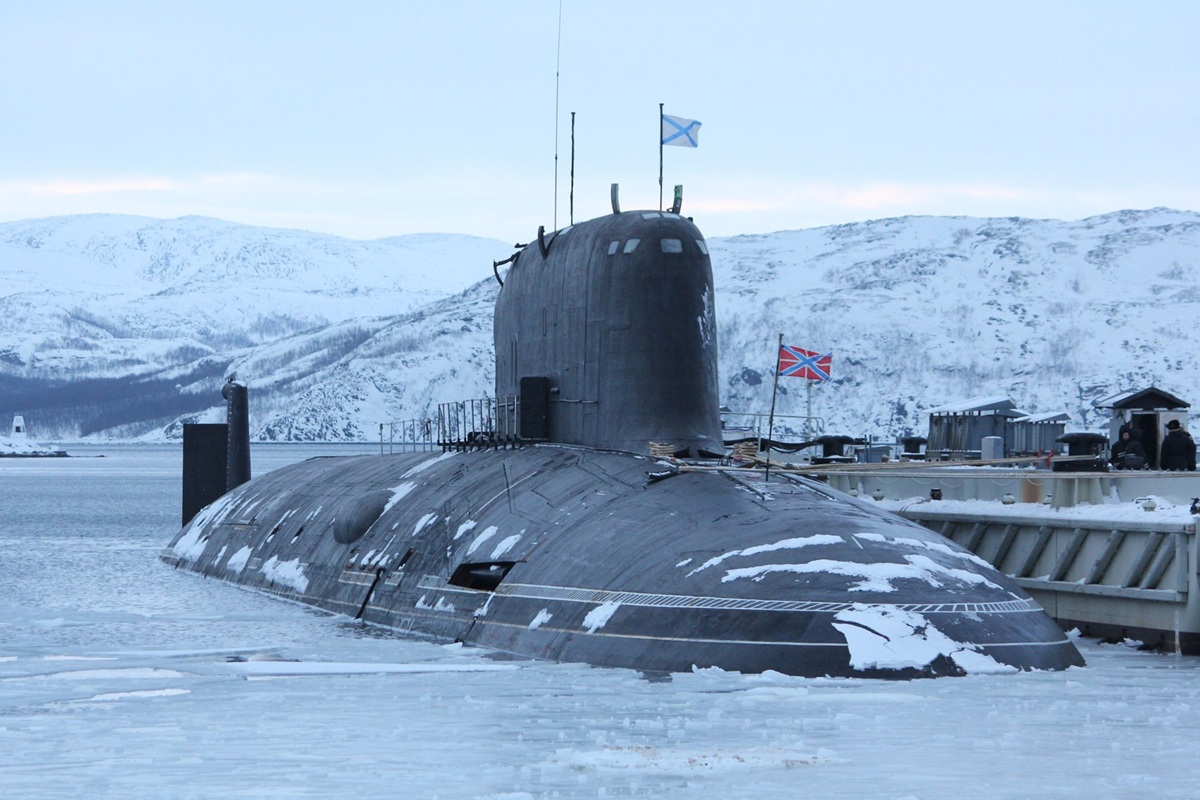 Russian Yasen-class K-560 Severodvinsk submarine. (Image Credit: Russian Ministry of Defense)
Current Capabilities, With Notable Specifics
The clearest institutional expression of this strategy is GUGI, the Main Directorate for Deep-Sea Research, a unit that reports directly to the Ministry of Defense rather than through the conventional naval chain of command. The Royal United Services Institute has linked GUGI to sensor emplacement for Russia's "Harmony" seabed surveillance network as well as the removal of foreign taps on undersea cables, in addition to its potential offensive role during a crisis.
GUGI's flagship asset is Losharik (AS-31/AS-12), a nuclear-powered deep-diving submersible built from a series of interconnected titanium spheres, a hull design that distributes pressure across seven joined spherical chambers, allowing operation at depths up to roughly 2,500 meters, with some Western estimates putting its maximum test depth closer to 6,000 meters (19,700 feet). Losharik suffered a fire in July 2019 that killed fourteen crew members, and has spent years in repair; as of 2024-2025, Russian shipbuilding sources indicated it was nearing completion, with sea trials expected to progressively increase toward its maximum operating depth. Its value lies precisely in the tasks named above: accessing strategic undersea cables and challenging the security of global digital infrastructure, whether through mapping, tapping, or, in a crisis, damage.
Losharik does not operate alone; it requires a mothership. That role now falls chiefly to Belgorod, a converted Oscar-II-class hull that Russian and Western sources agree is the largest submarine ever built, lengthened to 184 meters to accommodate both Poseidon nuclear-powered torpedoes and a bay for deep-diving midget submarines like Losharik. Belgorod thus fuses two missions in a single platform: it is simultaneously a delivery system for the Poseidon "doomsday" weapon and a covert-access vehicle for seabed infrastructure operations: a materialization, in one hull, of the dual logic of deterrence and infrastructure warfare described above. A second, older mothership, the modified Delta-class submarine Podmoskovye, performs a related function primarily in the High North, operating alongside Belgorod in under-ice missions.
Above the submarine layer sits a fleet of ostensibly civilian research and survey vessels, of which Yantar is the best documented example, a ship whose loitering patterns near cable landing sites and undersea infrastructure have drawn sustained NATO attention since the mid-2010s. This "research vessel" cover is not incidental; it is a feature of the strategy, since it keeps activity beneath the threshold of what any state can openly contest.
The empirical record of disruption is no longer hypothetical. Between late 2024 and early 2025, a cluster of incidents in the Baltic Sea drew direct attention to this toolkit. The tanker Eagle S was seized by Finnish authorities in late 2024 after the destruction of a cable connecting Finland and Estonia. Investigators found that it was equipped with signals-interception equipment and had also dropped sensor devices in the English Channel, suggesting that the vessel's function extended beyond commercial shipping.
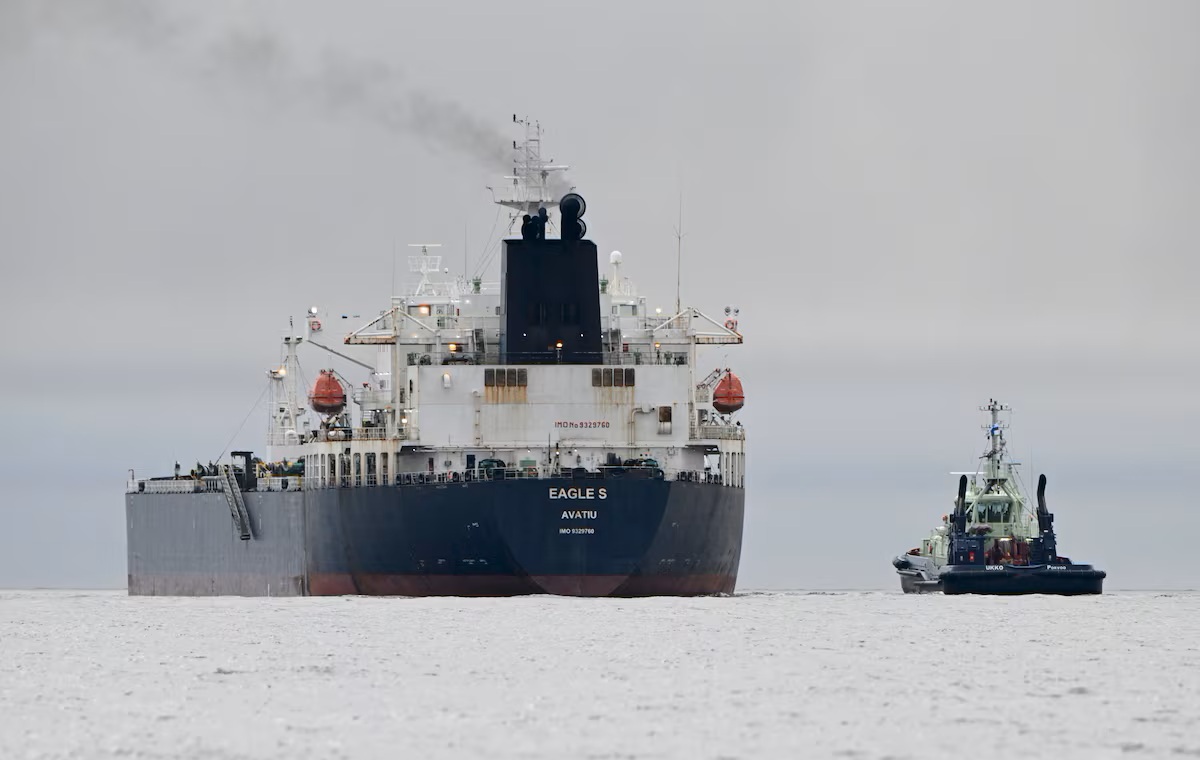 Finnish tugboat Ukko is seen near Oil tanker Eagle S outside the Porkkalanniemi, Kirkkonummi, on the Gulf of Finland on December 28, 2024. (Image Credit: Jussi Nukari/Lehtikuva)
Separately, the BCS East-West Interlink, a 218-kilometer cable linking Lithuania and Sweden, was damaged in an incident Western officials attributed, with some uncertainty, to a ship's anchor, possibly dragged deliberately or under intelligence direction; weeks later, in February 2025, the operator Cinia reported a further break in a Germany-Finland data cable near Gotland, again with sabotage suspected. None of these incidents produced a definitive attribution suitable for a conventional response, which is itself the analytically important point: this is a domain where ambiguity, not concealment, is the operative defense.
The response has been institutional as much as technical: the Royal Navy announced it would field a dedicated cable-protection vessel to address exactly this category of threat, a small but telling admission that undersea infrastructure now requires its own defensive doctrine rather than being folded into general anti-submarine warfare.
Planned and Emerging Developments
Several trajectories extend current investment rather than requiring speculation: further GUGI seabed-sensor emplacement to expand the Harmony network; building new underwater robots; AI-assisted acoustic classification intended to automate the currently manpower-intensive task of distinguishing submarine signatures from marine life and decoys; and continued Arctic infrastructure buildout tying seabed sensors to under-ice drone patrols, aimed at protecting the Borei-class SSBN bastion as the ice recedes and the region becomes more accessible to NATO surveillance.
Conceivable Future Developments
Further out and genuinely uncertain: distributed autonomous UUV swarms performing reconnaissance or infrastructure inspection at a scale no crewed fleet can match; long-dormant seabed installations: sensors or communication relays inactive for years before activation; and further integration of Losharik-class assets with AI-driven "cognitive ocean" mapping that would let a single mothership direct several unmanned systems simultaneously. None of this is confirmed doctrine; it is a plausible extrapolation from a fleet that already treats the seabed as an operational space.
Why Westphalian IR Struggles Here
Classical realism inherits, largely uncritically, the spatial imagination of the 1648 Peace of Westphalia: sovereignty is territorial, borders are fixed lines, and power projects from one bounded container across to another. Paired with a Newtonian notion of absolute, measurable space, this model works tolerably well for land warfare and even surface fleet competition, where physical distance correlates reasonably well with vulnerability and warning time.
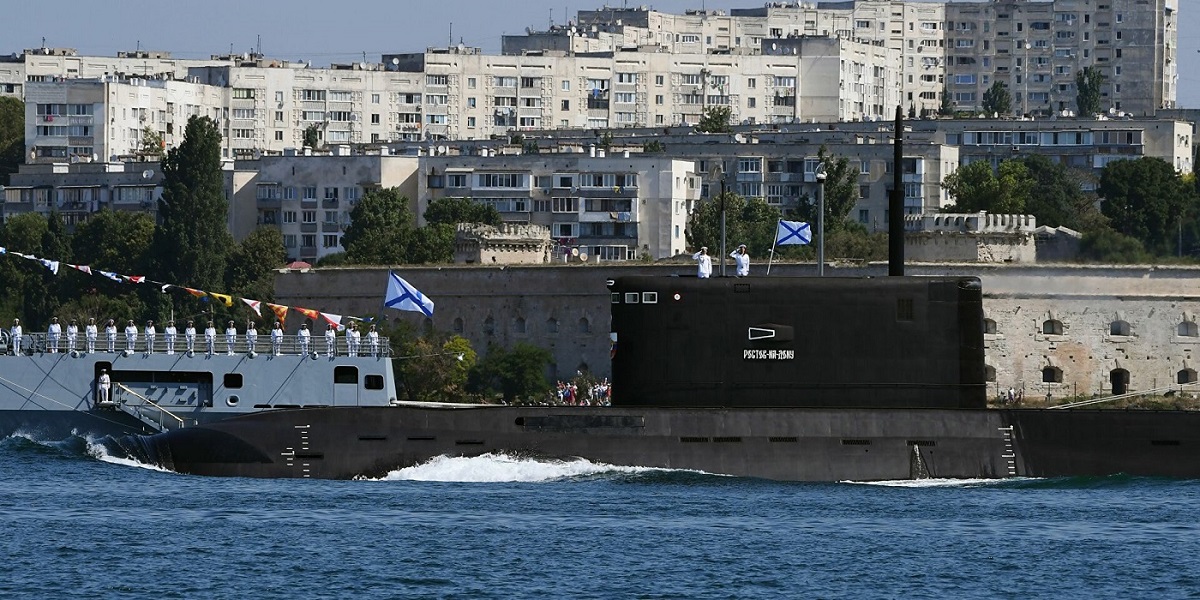 Russian Navy's Rostov-on-Don submarine takes part in a parade on Navy Day. (Image Credit: Sputnik/Ilya Pitalev)
The undersea domain described above breaks both premises in ways the empirical record makes concrete rather than merely conceptual. It is volumetric, not territorial: Losharik's mission profile exists simultaneously at a depth and pressure regime no surface-bound legal or strategic category was built to address. There is no seabed equivalent of a border crossing. It is relational rather than geometric in its treatment of distance: acoustic detectability depends on thermal layers, salinity, and seasonal propagation conditions far more than on kilometers, so a "close" submarine may be effectively invisible and a "distant" one exposed. And its decisive actors are not solely states: the Eagle S case shows a nominally commercial vessel functioning as an intelligence platform, and GUGI itself operates partly outside the conventional naval chain of command: agency is distributed across cables, sensors, ambiguous-status ships, and directorates in a way state-centric theory has trouble narrating cleanly.
Toward a Better Theoretical Synthesis
A more adequate framework keeps realism's core insight, that survival and relative power still matter, and Russia's bastion strategy is straightforwardly about assured second-strike, while supplementing it with tools built for relational space.
Stuart Elden's work on volume, rather than territory, as the object of contemporary security concern captures why depth itself, not just seabed area, is strategically salient in a way flat maps cannot represent. Philip Steinberg's writing on the social construction of ocean-space explains why the same physical water column can be legally, commercially, and militarily coded in incompatible ways simultaneously, exactly the ambiguity surrounding GUGI-linked activities.
Actor-network theory disperses agency across cables, sensors, and ambiguous-status vessels rather than locating it only in state decision-makers, which fits a domain where a "research ship" and a spy platform can be the same hull. Assemblage theory would treat the Belgorod-Losharik-Poseidon combination as a single composite system whose strategic effect exceeds any one named platform. And complexity theory captures why a single cable cut or misattributed incident can cascade into diplomatic consequence disproportionate to its physical scale, which is precisely what the 2024-2025 Baltic incidents demonstrated: genuine uncertainty about attribution, rather than resolution, was the strategically useful outcome.
Beyond Sea Control
Russia's undersea investments, such as GUGI's directorate structure, the Losharik-Belgorod-Podmoskovye triad, Poseidon, and the Baltic cable incidents now on the public record, do not appear to constitute a strategy aimed at defeating the U.S. Navy outright. They constitute a sustained effort to make naval superiority less decisive, by shifting competition into a domain organized around volume, ambiguity, and connectivity rather than territory and fixed distance.
International Relations theory's inherited Westphalian and Newtonian spatial assumptions can describe the deterrence logic well enough, but they struggle badly with the ambiguous-actor, ambiguous-attribution character of the domain itself. A synthesis of realist attention to survival and power with volumetric, relational, and network-theoretic tools offers a more accurate account, one built for an ocean understood as a contested space of flows and ambiguity rather than a surface to be controlled.
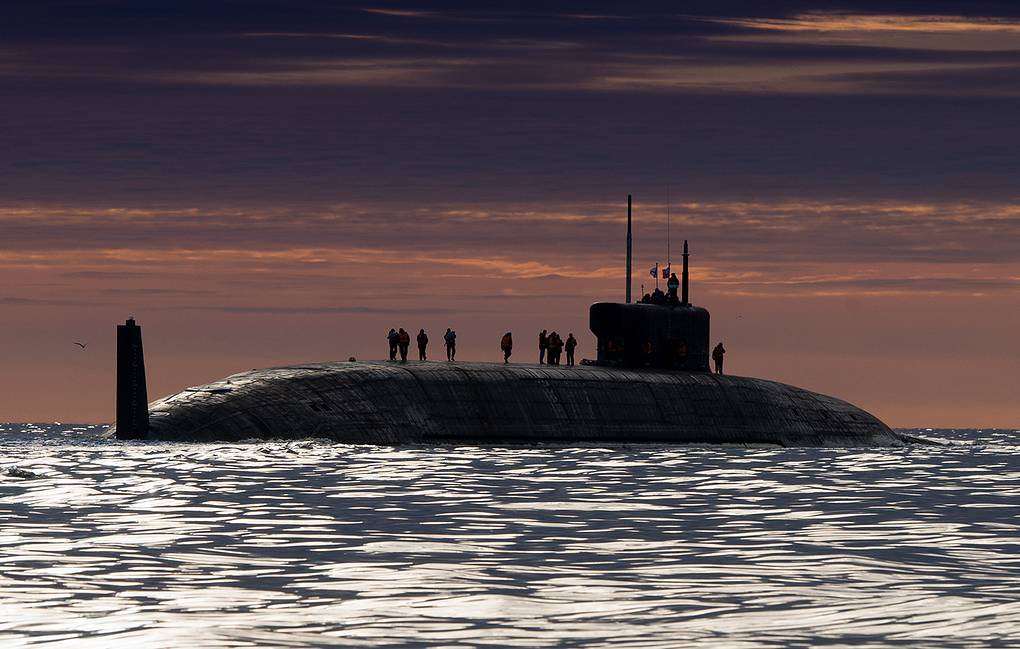 Project 955A nuclear-powered submarine Knyaz Oleg (Image Credit: Oleg Kuleshov/TASS)
Dr. Yashwant Singh is an Indian sociologist working at the intersection of urban studies, development, nature and geopolitics. He holds an M.Phil. in Sociology from the University of Delhi and a Ph.D. from the University of Hyderabad, and recently served as Assistant Professor of Sociology at GITAM (Deemed to be) University, Bengaluru. Alongside his academic work, his essays and analyses have been published across several international platforms, including Across Voices, Modern Diplomacy, Geostrategic Media, South Asia Journal, World Geostrategic Insights, and IA-Forum, where he offers sociological and analytical perspectives on global affairs, strategic developments, and the changing dynamics of contemporary societies.
Note: The above opinions are the personal views of individual authors or contributors and do not necessarily reflect the views of IRIA.
ALSO READ:
 Europe’s Drone Ambitions Face an ITAR Challenge
 PANAMAX 2026 Multinational Military Exercise
Regions




Issues