





Chinese Foreign Policy Interests in Iran
China’s growing energy needs and Iran’s plentiful resources laid the foundation of contemporary relationship between Beijing and Tehran. But the association between two countries is also founded on economic ties, defense cooperation, and geostrategic balancing against the United States. The main objective of this paper is to analyze the Chinese foreign policy towards Iran’s Nuclear Program, as well as to point out the driving factors of the cordial relations between Islamic Republic of Iran and Peoples Republic of China with regards to the Nuclear Program of Iran which is widely considered a threat to U.S. and its allies in the middle-east.
Keywords: China, Iran, Nuclear Program, Foreign Policy, U.S.
Introduction
China and Iran have been building a relationship mainly based on economic, strategic and regional cooperation over the years. The major Chinese interest underlying the diplomatic-friendly policy towards Iran seems to lie in many different factors ranging from political, cultural to economic and energy.
As Iran's nuclear programs escalated in early 2000s, U.S. started to impose sanctions on Iran, compelling many foreign firms to step back from investing in Iran. This prospect strengthened Iran and China relation, as China stepped into new energy deals with Iran.
In January 2013, Chinese Foreign Ministry spokeswoman Hua Chunying said that “China has consistently opposed sanctions against Iran over its peaceful nuclear energy program.” Further renewing China's stance on the issue, she stated that “We have always seen negotiations and cooperation as the best way to solve the Iranian nuclear issue.”
The Chinese policy clearly demonstrates that China has shown keen support for Iran’s right to a peaceful nuclear technology, as China has also voted in favor of certain United Nations Security Council (UNSC) resolutions aimed at Iran’s nuclear enrichment program.
In recent times, Beijing and Tehran have proclaimed that their ties extend beyond trade, energy, infrastructure sectors as both aspire to enhance people-to-people and cultural exchanges.
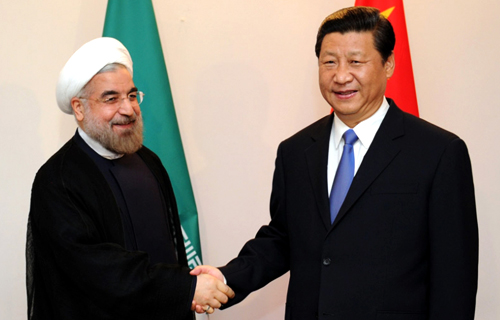
During the 12th Meeting of the Council of Heads of Member States of the Shanghai Cooperation Organization (SCO) in Beijing, Iranian president expressed hope to ease tension over its' Nuclear issue through negotiations and introduced his nation's nuclear policies to Chinese President Hu Jintao. Concurrently, the amiable relations between Iran and China present a complex challenge to United States objectives and interests in the middle-east region.
This report sheds light on key issues namely: why Chinese foreign policy differs from United States’ on Iran’s Nuclear Program, what are the main interests of China for being affable to Iran, and the key interests of Iran towards friendly relationship with China. To conclude this report, an analysis of the whole picture has been projected by classifying the interests of both countries into political, economical and strategic relations.
International concern towards Iran was heightened dramatically in the summer of 2002, when the existence of two nuclear sites was revealed by an exiled Iranian resistance group.3 Within a year, the world realized that Iran was eager to produce enriched uranium, which could fuel nuclear weapons as well as nuclear reactors. The sites included a uranium mine at Saghand, a yellow cake production plant near Ardakan, a pilot uranium enrichment plant at Natanz, and a commercial-scale enrichment facility on the same site.
In addition, Iran was continuing work on a 1,000 megawatt nuclear reactor at Bushehr and was building a heavy water production plant at Arak, next to which Iran planned to build a 40 megawatt heavy water reactor. Beginning in March 2003, following revelations that Iran had concealed nuclear work from the International Atomic Energy Agency (IAEA), the Agency has been investigating Iran's nuclear history.
Iranian officials constantly claim that they are pursuing nuclear technology for peaceful civilian purposes only, such as generating electricity. But most international proliferation experts suspect the fundamentalist Muslim theocracy is using its nuclear program to enrich uranium to higher levels than necessary for civilian nuclear-energy production and secretly trying to manufacture nuclear weapons.4 Islamic Republic of Iran’s friendly relationships with Pakistan, China, North Korea and Russia also warrant particular attentions.
Click Here to Download the Full Report 